ThunderPhone
An AI voice agent platform that handles real phone calls for businesses — support, scheduling, sales — across 40+ languages, claiming better accuracy and lower per-minute cost than both human call centers and rival AI voice startups.
🔗 Visit ThunderPhone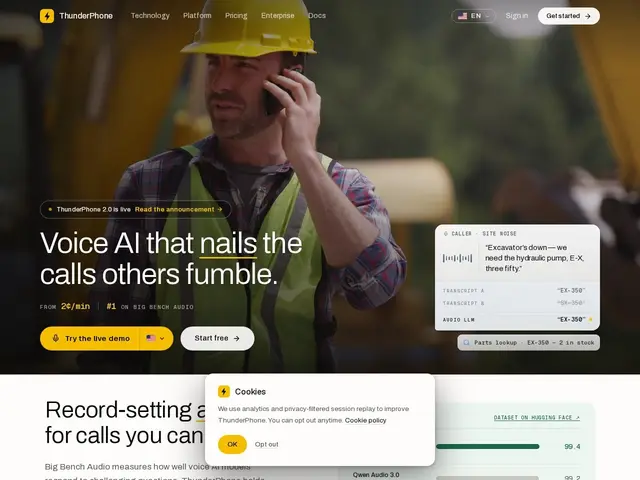
Description
AI voice agents that sound convincingly human on a phone call are a genuinely hard engineering problem: latency, interruption handling, background noise, and accents all break naive implementations. ThunderPhone is a platform built specifically to place and receive real business phone calls with an AI agent on the other end — across landline (PSTN), SIP trunks, web, and app channels — for use cases like customer support, appointment scheduling, pre-sales qualification, and outbound campaigns.
Its core technical claim is a "multi-path audio listening" architecture that fuses transcribed text with raw audio fed directly to the underlying language model, which it says drives a 99.4% transcription accuracy figure benchmarked against Big Bench Audio. It supports 40+ languages with the ability to switch languages mid-call, includes voicemail/screener detection with context-aware transfer to a human, live supervision where a human can guide the AI mid-call, and enterprise-grade compliance (HIPAA, GDPR) with SIP trunking for regulated industries like healthcare. Pricing starts at 2 cents per minute across three tiers (Spark, Bolt, Storm), positioned explicitly against both AI competitors charging 7 cents or more per minute and traditional human call centers charging $0.13 to $0.67+ per minute.
💬 Our review
The short version: ThunderPhone's pitch — noticeably cheaper than both human call centers and named AI competitors, with a specific accuracy benchmark to back it up — is credible and well-differentiated in an increasingly crowded voice AI space, but as with any AI-generated phone call product, real-world call quality is something you need to test yourself before betting a support line on it.
Against Vapi, Retell, and Bland — the named competitors ThunderPhone positions against — the headline differentiator is price (2¢/min vs. their 7¢+) plus the specific transcription-accuracy claim and mid-call language switching, which not all competitors emphasize. The HIPAA/GDPR compliance and SIP trunking support also signal it's aiming at regulated, enterprise-grade use cases like healthcare scheduling, not just hobbyist bots. The honest caveat with any voice AI vendor: benchmark numbers (99.4% on Big Bench Audio) measure something specific and controlled, and real phone calls with background noise, accents, and interruptions are messier — test with your actual call scenarios before committing budget. Pick ThunderPhone if per-minute cost and multilingual support matter and you're willing to pilot it; if you need the most battle-tested, widely-adopted option with the biggest integration ecosystem, Vapi or Bland currently have more market presence.
💰 Pricing
📊 Global score
🤖 AI-enriched data
From $0.02/minute across 3 tiers (Spark, Bolt, Storm); free tier via signup.
Pros
Priced below both human call centers and named AI competitors
99.4% claimed transcription accuracy with a cited benchmark
40+ languages with mid-call switching
HIPAA/GDPR compliant, SIP trunking for enterprise/regulated use
Live human supervision option mid-call
Cons
Benchmark accuracy claims don't always match messy real-world call conditions
Newer/less-established than Vapi or Bland in market presence
Crowded, fast-moving voice AI category
Requires piloting with real call scenarios before trusting for critical lines