Shotium
A simple API that turns any URL into a screenshot or a ready-made social share (Open Graph) image with one GET request, built with SSRF protection and signed URLs for safe automated use.
🔗 Visit Shotium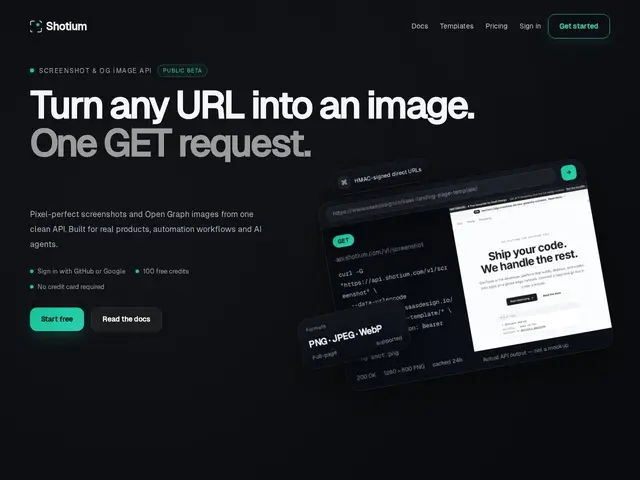
Description
Generating a screenshot of a webpage or a social-preview image programmatically sounds simple until you actually build it — headless browser infrastructure, caching, template layout, and security against server-side request forgery (SSRF) attacks all add up fast. Shotium packages all of that behind a single clean API: send a URL, get back a screenshot or a templated Open Graph image, no browser automation infrastructure to maintain yourself.
It supports full-page or custom-viewport screenshots, five pre-built OG image templates for social sharing cards, and multiple output formats (PNG, JPEG, WebP). For security, it hardens against SSRF (a real risk when your API fetches arbitrary user-supplied URLs) and supports HMAC-signed URLs so you can generate images client-side without exposing your API key. Results are cached for 24 hours. It's explicitly positioned for developers, AI agents, and automation workflows — not just human-triggered use — which shows up in a free community-built n8n integration node found independently of Shotium's own marketing, a reasonable signal of real early adoption.
💬 Our review
The short version: Shotium is a clean, focused, developer-friendly API for a genuinely common need (screenshots and OG images), and its security-conscious design (SSRF hardening, signed URLs) shows more engineering maturity than a typical weekend-project API wrapper.
Against established players like urlbox.io or ScreenshotOne, Shotium is newer and smaller, currently in public beta, so it's a bit of a leap of faith on long-term reliability and support compared to incumbents with longer track records. Its pricing is competitive though: $15/month for 2,000 renders undercuts several established screenshot APIs at similar volumes, and the free 100-credit tier is enough to prototype an integration before committing. The independent evidence of a community-built n8n node is a good signal — real users are already wiring it into automation pipelines, not just reading the marketing copy. Pick Shotium if you want a modern, security-conscious API at a competitive price and don't mind being an early adopter; pick a more established provider like urlbox.io if you need a longer proven track record for a production-critical pipeline.
💰 Pricing
📊 Global score
🤖 AI-enriched data
Free: 100 renders one-time; Starter $15/mo (2,000 renders); Growth $49/mo (10,000 renders); credit packs $10/1,000.
Pros
Single clean API for screenshots and OG images
SSRF hardening and HMAC-signed URLs for security
Competitive pricing vs. established providers
Multiple output formats and pre-built OG templates
Real independent adoption (community n8n node)
Cons
Public beta — newer and less proven than incumbents
Smaller team/track record than urlbox.io or ScreenshotOne
24-hour cache may not suit highly dynamic pages
Free tier is one-time credits, not recurring