Kavla
A free, local-first, infinite-canvas tool for exploring data with SQL — instead of a linear notebook, your queries and results become nodes you can arrange visually, with a teammate editing alongside you in real time.
🔗 Visit Kavla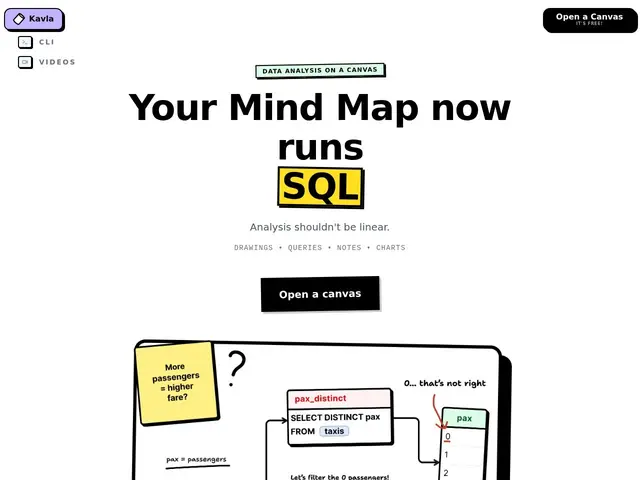
Description
SQL notebooks are linear by nature: cell after cell, top to bottom, which gets messy fast once an analysis branches into several directions you're comparing side by side. Kavla reframes data exploration as a spatial problem instead — an infinite canvas where each query and its results is a node you can place, connect, and rearrange freely, closer to a mind map than a notebook.
Technically, it runs on DuckDB WASM, meaning the actual SQL engine executes locally in your browser via WebAssembly rather than sending your data to a server — useful both for speed and for keeping data local. On top of that local-first engine, it adds real-time multiplayer collaboration, so a teammate can be arranging and querying the same canvas alongside you. It's positioned as free, with no account or server dependency required to start exploring a dataset.
💬 Our review
The short version: Kavla's combination of a local-first DuckDB engine with a visual, spatial canvas is a genuinely different way to explore data compared to the notebook format almost every other tool defaults to, and being free with no server dependency makes it easy to just try.
Against Jupyter notebooks or Hex, the visual canvas is the real differentiator — Hex in particular already does collaborative, shareable data work, but still in a mostly linear cell format, whereas Kavla's node-based canvas is closer to tools like Miro or Obsidian's graph view applied to SQL. The local-first DuckDB WASM approach also means no data leaves your browser by default, which is a real privacy/speed advantage over cloud-first BI tools. The tradeoff is that this is a newer, less-proven project — an infinite canvas is great for exploratory, branching analysis but may feel like overhead for simple linear queries where a notebook is faster to write. Pick Kavla when your analysis genuinely branches and benefits from spatial arrangement; stick with a notebook or spreadsheet for straightforward, single-path queries.
💰 Pricing
📊 Global score
🤖 AI-enriched data
Free, local-first, no account required to start.
Pros
Visual, spatial canvas instead of linear notebook cells
Local-first — SQL runs in-browser via DuckDB WASM, no server needed
Real-time multiplayer collaboration
Free to use
Cons
Newer, less-proven than established notebook tools
Spatial canvas may be overkill for simple linear queries
In-browser WASM execution has practical limits on very large datasets
Smaller ecosystem/community than Jupyter or Hex