Zelos
A unified data platform for hardware and mission-critical systems, consolidating telemetry, logs, and test results so engineering teams can observe and debug physical products from prototype to production.
🔗 Visit Zelos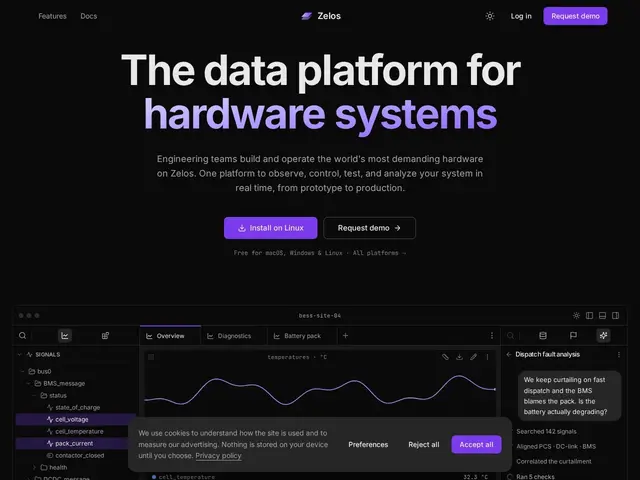
Description
Teams building physical hardware — robots, vehicles, batteries, industrial equipment — face a data problem software teams don't: telemetry comes from dozens of different protocols and vendor tools, and there's rarely one place to see it all together, compare a test run from last week to one from today, or ask a plain-language question about what a sensor was doing at a specific moment. Zelos is built to be that one place, pulling in signals from industrial protocols directly and giving engineers a single workspace to observe, control, and test hardware systems as they move from prototype to production.
Technically, it natively integrates with industrial protocols including CAN, Modbus, OPC UA, and EtherCAT, offers real-time signal monitoring and recording, side-by-side comparison of different test runs, AI-powered natural-language querying across collected data, precision measurement tools, shared team layouts, built-in remote control actions, and SDKs for Python, Rust, and Go plus CLI automation, with a local-first approach to data privacy. There's a free tier available for macOS, Windows, and Linux; paid tiers exist but pricing details aren't published. Zelos is Y Combinator-backed (S23 batch), founded by engineers who previously worked at Tesla and Neuralink — direct experience with exactly the kind of mission-critical hardware data problems the product addresses.
💬 Our review
The short version: Zelos's founder pedigree (Tesla, Neuralink) is a meaningful signal in a category where domain expertise in mission-critical hardware genuinely matters, and the native industrial-protocol support (CAN, Modbus, OPC UA, EtherCAT) is real, non-trivial integration work most general-purpose observability tools skip entirely.
Against building an in-house telemetry pipeline with open-source components (InfluxDB, Grafana, custom protocol parsers), Zelos's advantage is having the hardware-protocol integrations and cross-run comparison tooling already built, which is normally months of engineering effort for a hardware startup to replicate. Against generic IoT platforms not built specifically for engineering test-and-debug workflows, Zelos's focus on side-by-side run comparison and precision measurement is more purpose-built for hardware R&D than general fleet monitoring. The free tier is a reasonable way to evaluate fit before paid pricing (which isn't public) comes into play. Pick Zelos if your team is building physical hardware and currently stitching together vendor tools and spreadsheets to make sense of test data; it's not relevant if your systems are purely software.
💰 Pricing
📊 Global score
🤖 AI-enriched data
Free tier available (macOS, Windows, Linux); paid tiers exist but pricing not published.
Pros
Native support for industrial protocols (CAN, Modbus, OPC UA, EtherCAT)
Founded by ex-Tesla/Neuralink engineers with direct hardware-data experience
Side-by-side test-run comparison built specifically for hardware R&D
AI natural-language querying across collected telemetry
Free tier available across macOS, Windows, Linux
Cons
Paid tier pricing not publicly disclosed
Only relevant for teams building physical hardware, not software-only products
Younger company (YC S23), still building out ecosystem
Requires investment to fully wire up all your protocol sources