Hatchet
An open-source orchestration engine for background tasks, AI agents, and durable workflows, self-hostable free or available as a managed cloud service.
🔗 Visit Hatchet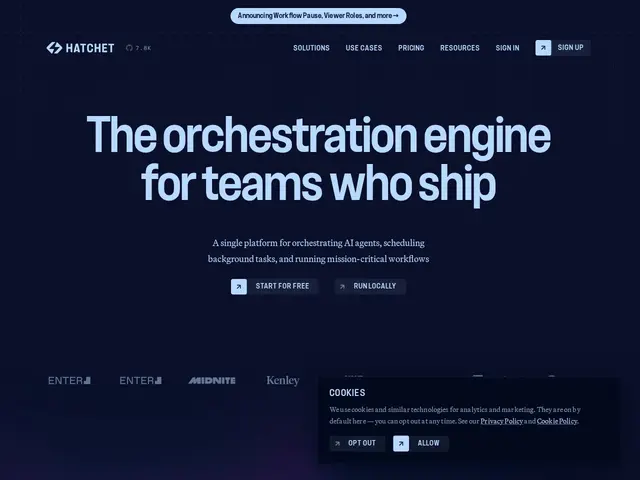
Description
Any application that needs to run things reliably in the background — send an email after a signup, retry a failed API call, run a nightly data job, coordinate a multi-step AI agent — eventually needs a task queue, and building one that handles retries, monitoring, and scaling correctly is harder than it looks. Hatchet is a ready-made orchestration engine for exactly that: background tasks, scheduled jobs, and durable multi-step workflows, with the reliability engineering (retries, monitoring, DAG-based composition) already built in.
Technically, Hatchet provides durable task execution with automatic retry policies, DAG-based workflow composition, event triggers and webhook integration, worker affinity and task routing, a real-time monitoring dashboard with full task history, OpenTelemetry tracing and Prometheus metrics, and SDKs for TypeScript, Python, Go, and Ruby. It's fully open-source under the MIT license with 7,800+ GitHub stars, and can be self-hosted for free or run as a managed cloud service. Cloud pricing starts with a free tier (100,000 task runs/month), then $10 per additional million runs, with Team ($500/month, 10 users/5 tenants) and Scale ($1,000/month, unlimited users/tenants, HIPAA support) tiers above that, plus custom Enterprise pricing for very high volume. It's Y Combinator-backed (W24 batch).
💬 Our review
The short version: Hatchet is a solid, credible choice if you need a real task-orchestration layer and want the option to self-host for free rather than being locked into a managed service — the MIT license and healthy GitHub star count are good signs of a maintained, trustworthy project.
Against Celery (Python) or BullMQ (Node), which are the traditional open-source task-queue defaults, Hatchet's pitch is a more modern feature set out of the box — DAG-based workflows, built-in observability, and specific support for orchestrating AI agent workflows — rather than requiring you to bolt those on yourself. Against a fully managed service like Temporal Cloud, Hatchet's free self-hosted tier is the more budget-friendly entry point for smaller teams, with the option to move to managed cloud later without switching tooling. The generous free cloud tier (100K runs/month) makes it easy to evaluate without commitment. Pick Hatchet if you're building anything with meaningful background-job or AI-agent-orchestration needs and want open-source optionality; a simpler cron job may suffice if your needs are genuinely basic.
💰 Pricing
📊 Global score
🤖 AI-enriched data
Free self-hosted (MIT) or cloud free tier (100K runs/mo), then $10/1M runs; Team $500/mo; Scale $1,000/mo; Enterprise custom.
Pros
Fully open-source (MIT), self-hostable for free
Modern feature set: DAG workflows, built-in observability, retries
Built-in support for AI-agent task orchestration
Generous free cloud tier (100,000 runs/month)
Multi-language SDKs (TypeScript, Python, Go, Ruby)
Cons
Cloud pricing rises quickly for larger teams ($500-$1000/mo tiers)
Newer than Celery/BullMQ, smaller long-term track record
Self-hosting requires your own ops effort to run reliably
Enterprise HIPAA/SLA support gated behind higher tiers