Klenty
AI-driven multichannel outreach and a power dialer that can place up to 350 calls an hour, built for SDR teams chasing pipeline at scale.
🔗 Visit Klenty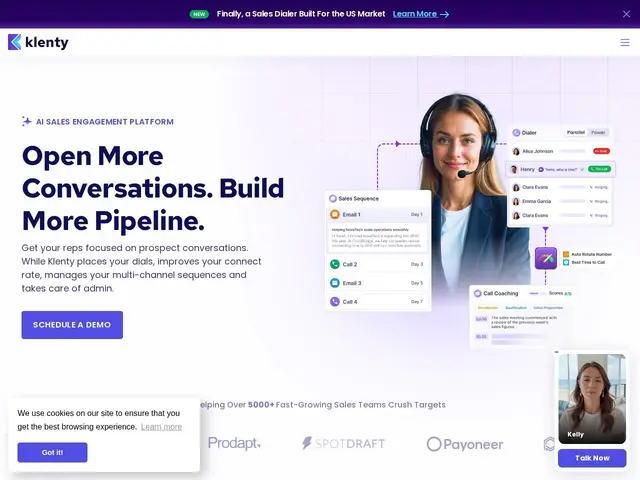
Description
Klenty is a tool that helps sales reps stop losing track of who they were supposed to call, email, or text next. Instead of a rep manually juggling spreadsheets and reminders, Klenty builds an automatic sequence — an email today, a LinkedIn message in two days, a phone call next week — and works through it for a whole team of reps at once. Think of it as a shared to-do list for cold outreach that also picks up the phone and dials for you, skipping voicemail boxes and busy signals so a rep only talks to a live person.
Under the hood, Klenty is built around "cadences" — AI-generated multi-step sequences across email, phone, SMS, and LinkedIn — paired with Parallel and Power Dialers that can push through up to 350 calls per hour, with AI voicemail and IVR detection to filter out dead ends. It adds AI call coaching that scores reps against a talk-track script, plus deliverability monitoring to keep sender reputation healthy, and integrates with Salesforce, HubSpot, Pipedrive, Zoho, and MS Dynamics. Klenty says it serves 5,000+ customers. Pricing is subscription-based with a 14-day free trial, but exact tier prices aren't published on the site — worth asking about directly before committing.
💬 Our review
The short version: Klenty is a solid pick if your team lives on the phone as much as email — the dialer throughput is the real differentiator, not the AI branding.
Compared to Reply.io and Apollo.io, which lean harder into broad multichannel sequencing and (for Apollo) a built-in contact database, Klenty's edge is call volume: 350 calls/hour with voicemail detection is a genuine time-saver for high-volume dialing teams, and the AI call coaching adds a layer neither Reply nor Apollo emphasizes as strongly. The catch is pricing transparency — Klenty doesn't publish its tiers, which makes it hard to comparison-shop against Reply.io or Apollo.io's freemium entry point without booking a call first. If your outreach is mostly email-and-LinkedIn with light calling, Reply.io or Apollo.io's freemium tier will get you started for less friction. If dialing volume is your bottleneck, Klenty's dialer stack is worth the demo.
💰 Pricing
📊 Global score
🤖 AI-enriched data
Subscription-based, 14-day free trial, no credit card required. Exact tier pricing not published on the website; serves 5,000+ customers.
Pros
Power/Parallel Dialer supports up to 350 calls per hour
AI voicemail and IVR detection cuts wasted dial time
AI call coaching scores reps against talk-track adherence
Multichannel cadences across email, phone, SMS, and LinkedIn
Deep CRM integrations (Salesforce, HubSpot, Pipedrive, Zoho, MS Dynamics)
Cons
No published pricing tiers — must talk to sales to get a quote
Heavier focus on calling means less differentiation if your team is email-first
5,000 customers is modest next to category leaders like Apollo or Outreach
AI account research features are newer and less proven than the core dialer