Apollo.io
A B2B sales platform with 240M+ contacts built in, combining lead databases, outreach automation, and deal tracking so teams don't need five separate tools.
🔗 Visit Apollo.io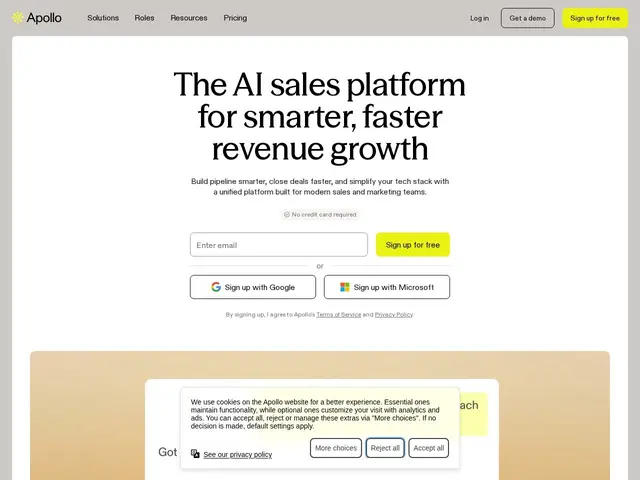
Description
Apollo.io is aimed at a common problem for sales teams: you need to find who to contact, get their real email and phone number, reach out to them, and then track the deal — and normally that means stitching together four or five different tools. Apollo bundles all of that into one product: a giant searchable database of business contacts and companies, automation to send them emails and messages, tools to spot who's visiting your website, and a dashboard to track where deals stand. It's built for anyone doing B2B sales, from individual founders to large revenue teams, who wants fewer logins and less manual copy-pasting between apps.
The core asset is scale: a database Apollo says covers 240M+ contacts and 30M+ companies, which is large even by industry standards. On top of that sits AI-driven multichannel campaign automation, real-time form enrichment and website-visitor identification, call recording with conversation intelligence, AI meeting summaries, and a workflow automation engine, plus integrations into Salesforce, HubSpot, and others. Apollo offers a free tier with limited features and paid tiers above it, though exact pricing for the paid plans isn't detailed on the homepage. Its main differentiator versus point-solution competitors like Reply.io or Klenty is that the contact database is native to the product rather than something you have to buy or integrate separately.
💬 Our review
The short version: Apollo.io is the strongest pick if you need both a contact database and outreach automation, since most competitors force you to buy one and bolt on the other.
Against Reply.io and Klenty, both of which do sequencing and dialing well but ship with no contact data of their own, Apollo's built-in database of 240M+ contacts is the clear differentiator, and the free tier makes it easy to try before paying for anything. The trade-off is depth: teams that need best-in-class call coaching (Klenty) or the most polished multichannel sequencing (Reply.io) may find Apollo's version of each feature merely good, not great, since it's spread across so many capabilities. Data accuracy at that scale is also a common complaint in the category generally — worth validating on a sample before rolling out broadly. Pick Apollo if you want one tool instead of five; pick Klenty or Reply.io if you already have a data source and just need best-in-class outreach.
💰 Pricing
📊 Global score
🤖 AI-enriched data
Free tier with limited features; paid tiers available but exact pricing not detailed on the homepage.
Pros
Built-in database of 240M+ contacts and 30M+ companies — no separate data provider needed
Consolidates lead gen, outreach, enrichment, and deal tracking in one platform
Free tier available, lowering the barrier to try the product
Real-time form enrichment and website-visitor identification
Call recording and conversation intelligence built in
Cons
Exact paid-tier pricing not published on the homepage
Doing many things at once means individual features may lag best-of-breed specialists like Klenty's dialer
Contact database accuracy/freshness at this scale is a known industry pain point worth testing directly
Broad feature surface can mean a steeper learning curve for teams that just want simple outreach