DNSniffer
A free searchable database of 364+ million domains built from Certificate Transparency logs and ICANN zone files, with brand-monitoring alerts and a public JSON API.
🔗 Visit DNSniffer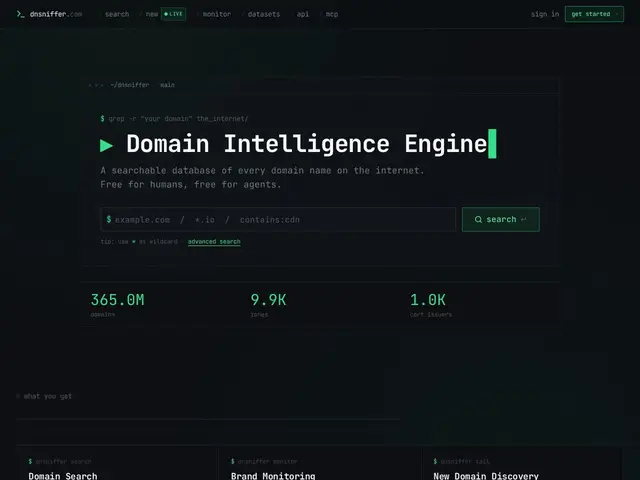
Description
Every time a website gets an SSL certificate or a domain name gets registered, that fact becomes public record somewhere on the internet — buried across certificate logs and registry files nobody has time to read. DNSniffer is like a search engine for that hidden paper trail: type in a company name, a keyword, or a wildcard pattern, and it tells you every matching domain it has found, when it first appeared, and what certificate authority issued its SSL certificate. It's aimed at people who need to know what's out there on the web, whether that's a security researcher hunting for phishing lookalikes of their company's domain, or a developer curious which domains are using a particular certificate issuer.
Under the hood, DNSniffer continuously ingests Certificate Transparency logs (the public audit trail every CA must publish) and ICANN's Centralized Zone Data Service feeds, building a searchable index that currently covers over 364 million domains across hundreds of TLDs. Results can be queried through a web UI, a free read-only JSON API with cursor-based pagination, a live WebSocket feed of newly-indexed domains, or daily bulk CSV exports per TLD or certificate authority. It also ships an MCP server so AI agents (like Claude) can query domain data directly, and a brand-monitoring feature that emails daily alerts when new lookalike domains targeting a given brand are detected.
💬 Our review
The short version: if you need to search public domain and SSL certificate data without paying for a SecurityTrails or Censys subscription, DNSniffer is a genuinely useful free alternative, though it's younger and less proven than the established players.
DNSniffer's core pitch — treating CT logs and zone files as a commodity rather than a premium product — is a real point of differentiation against tools like SecurityTrails, Censys, or crt.sh's raw interface, all of which either gate bulk access behind paid tiers or require technical comfort with raw certificate data. DNSniffer wraps that same underlying public data in a friendlier search UI, a documented JSON API, and ready-made bulk CSV exports, all free with no rate limits stated. The trade-off is that it's built at single-maintainer scale (a DataChaser.com project) rather than by an enterprise security vendor, so there's no SLA, no support contract, and coverage/uptime claims aren't independently verified. For casual domain research, brand-monitoring on a budget, or scripting against a free API, it's a solid pick; for mission-critical threat intelligence at a company, it's worth pairing with — not necessarily replacing — established paid platforms.
💰 Pricing
📊 Global score
🤖 AI-enriched data
Free for everyone — web search, JSON API, and CSV exports all free with no credit card or account required.
Pros
Completely free, no account needed
364M+ domains indexed from CT logs and zone files
Free JSON API with no stated rate limits
MCP server for AI agent integration
Cons
Single-maintainer side project, no SLA
No stated data-freshness or uptime guarantees
Less mature/polished than established paid platforms
No mention of historical data retention limits