RepoWorld
Turns a GitHub repository into an explorable 3D city — files become buildings, open issues become creatures you can hunt with an AI code-review tool.
🔗 Visit RepoWorld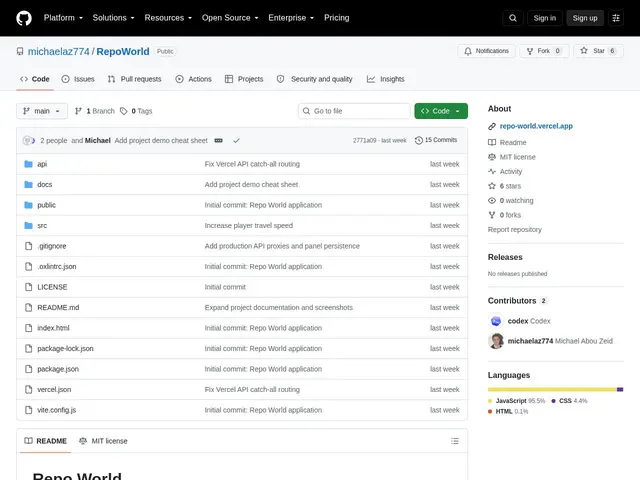
Description
Reading an unfamiliar codebase usually means scrolling through a file tree and guessing what's big or important. RepoWorld tries a different approach: give it a GitHub repo URL and it builds a little 3D city out of it that you walk around in like a video game — big files become tall buildings, folders become neighborhoods, and the programming languages used change what the buildings look like. Open issues and pull requests show up as creatures wandering the streets, and you can 'hunt' one to get an AI-generated writeup of what the underlying issue actually is.
Under the hood it's a Vite + React Three Fiber (three.js) front end with a small Vercel serverless backend that calls the GitHub API for repo data and the Greptile API for the AI issue analysis triggered when you approach a bug creature. It maps file size to building height and dependencies to glowing arcs between buildings, and only ever performs read (GET) operations on the target repo, so there's no risk of it modifying your code. Notably, it ships a fully offline demo mode (type 'demo' on the landing screen) that needs no GitHub token, no Greptile key, and no network connection at all, alongside a live hosted version at repo-world.vercel.app — so it's genuinely runnable rather than just screenshots of an idea.
💬 Our review
The short version: a fun, working hobby project that makes exploring a codebase feel like a game, but it's a tiny, early-stage tool rather than something you'd rely on for real code review.
Compared to mature codebase-visualization tools like GitHub's own Insights/dependency graph or commercial products like CodeSee and Sourcetrail, RepoWorld trades depth and scale for novelty: its 3D-city metaphor is genuinely fun to walk around in and it does tie into real GitHub issues via the Greptile API, but it can't compete on rigor, team features, or handling very large monorepos. Compared to Gource, the classic tool for visualizing repo history, RepoWorld focuses on current structure rather than commit history over time, and adds an AI-analysis layer Gource doesn't have. With only 6 stars, 0 forks and 15 commits, it reads as a weekend/hackathon-scale project rather than a maintained product — but because it's free, open source, read-only, and has a genuine zero-setup offline demo, there's essentially no cost to trying it just to see a familiar repo from a completely different angle.
💰 Pricing
📊 Global score
🤖 AI-enriched data
Free and open source (MIT license); the offline demo needs no account, while the live/AI-analysis features depend on free-tier GitHub and Greptile API limits.
Pros
Actually runnable, not just a concept — offline demo mode needs zero setup
Real GitHub API + Greptile AI integration ties the visualization to genuine repo issues, not decoration
Free and open source (MIT)
Read-only against the target repo, so it's safe to point at any public project
Cons
Very early/small project (6 stars, 0 forks, 15 commits) — long-term maintenance is unclear
AI analysis feature depends on the third-party Greptile API and its own key/rate limits
3D city navigation doesn't scale well as a way to understand very large monorepos
Not a substitute for real static analysis, code review or documentation tools