Rysh CLI
An agentic terminal multiplexer where every pane can run tabs, splits, and vim/htop as usual — or act as an AI agent (Claude or Codex) that reads prompts and calls tools.
🔗 Visit Rysh CLI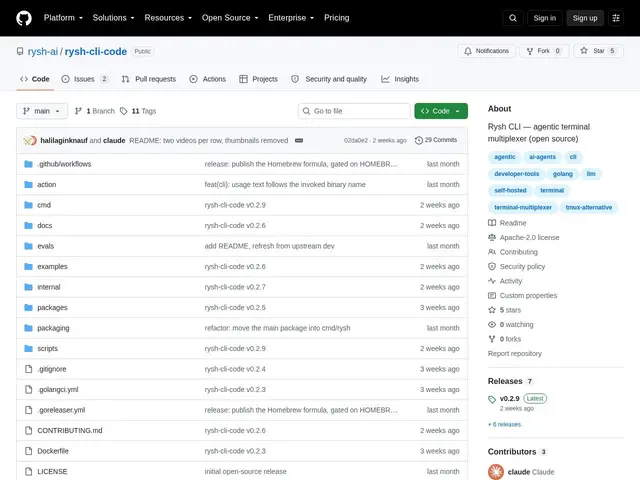
Description
If you've ever used a program like tmux to split your terminal into multiple panes so you can run several things at once — a code editor in one pane, logs in another, a shell in a third — Rysh CLI does that same job, but with a twist: any of those panes can also become an AI agent that reads your instructions and does the work itself. Instead of typing every command by hand, you can tell one pane to fix a bug while another writes tests, then check back on both later, the way you might glance between several browser tabs.
Under the hood, Rysh CLI is written in Go and rebuilds the terminal multiplexer experience — tabs, panes, splits, session persistence — around an actor-based workspace that treats each pane as either a normal shell or an LLM-backed agent powered by Claude or Codex. Agents can resume where they left off after you close and reopen your terminal, and a built-in "agents board" lets multiple agents leave messages for each other to coordinate on shared tasks, with a "fleet" concept for grouping related panes. A feature called SecretNAT swaps real credentials for tokens before any request leaves your machine, so API keys aren't handed directly to the LLM provider. It's open source under Apache-2.0, installable via `go install` or a prebuilt script, and squarely aimed at developers already comfortable with terminal multiplexers who want to add AI agent orchestration on top.
💬 Our review
The short version: Rysh CLI is a clever mashup of a tmux-style terminal multiplexer and a multi-agent AI coding harness, useful if you already live in the terminal and want several Claude/Codex agents working in parallel panes rather than juggling separate windows.
Compared to plain tmux or Zellij, Rysh CLI adds real value for AI-agent-heavy workflows: agent-aware panes, session persistence for long-running agent conversations, and an agents board for coordination that neither tmux nor Zellij offer natively. Compared to other AI coding harnesses layered on top of a single provider, Rysh CLI's edge is being provider-agnostic (Claude and Codex) and terminal-native rather than IDE-native. That said, it's a very young project (single-digit GitHub stars, no track record yet), the SecretNAT credential-protection mechanism hasn't been independently audited as far as we could confirm, and Windows support requires WSL2 since native PTY support is missing. For developers already fluent in terminal multiplexers who want to experiment with running several coding agents at once, it's free and worth a try; for anyone not already comfortable in tmux-like environments, the learning curve may not be worth it yet.
💰 Pricing
📊 Global score
🤖 AI-enriched data
Free and open source (Apache-2.0). No hosted or paid tier documented.
Pros
Each pane can be a full AI agent, not just a shell
Supports both Claude and Codex providers in the same session
Session persistence — agents keep working across terminal restarts
Agents board enables multi-agent coordination on shared tasks
Open source, free, Apache-2.0
Cons
Very young project (single-digit GitHub stars), unproven at scale
No native Windows support — requires WSL2
SecretNAT credential protection not independently audited (as far as we found)
Steeper learning curve than tmux for users unfamiliar with terminal multiplexers