Metis
An open-source, model-agnostic AI coding agent that uses a multi-agent Plan/Build workflow and persistent memory to push cheaper models like DeepSeek toward the coding performance of top-tier models like Claude Opus.
🔗 Visit Metis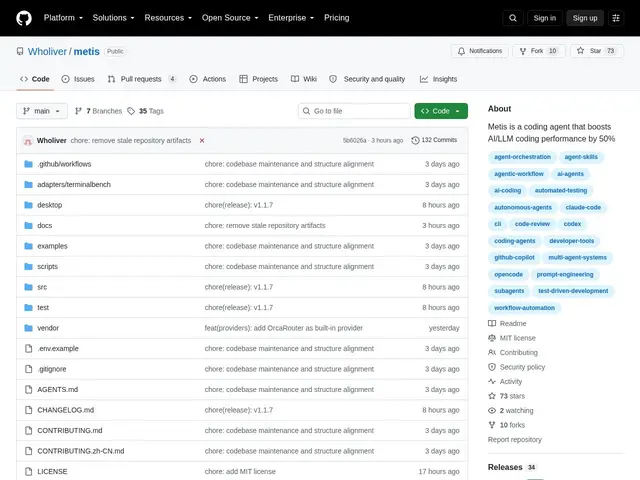
Description
Most AI coding assistants get you one shot: you ask, a single model reasons and writes code in one pass, and if it forgets something from ten minutes ago, that's on you to catch. Metis is built around a different idea — instead of one AI doing everything, it runs a small team of specialized agents that plan before they touch anything, delegate sub-tasks to each other, remember what happened in past sessions, and check their own work with automated verification before calling a task done. It's aimed at developers who want an autonomous coding agent that behaves less like a chatbot and more like a disciplined engineer.
Technically, Metis is a TypeScript project available as a terminal TUI, an npm-installable CLI, and a React/Vite desktop app for macOS and Windows. It runs a recursive multi-agent architecture (named agents delegating through L0→L4 levels), a 'Plan ↔ Build' dual mode that separates safe, read-only investigation from actual file changes, and persistent SQLite memory with vector search that survives across sessions, plus Git Worktree isolation for safe parallel tasks. It's explicitly model-agnostic — OpenAI, Anthropic, DeepSeek, Gemini, Groq, Ollama, vLLM and OrcaRouter are all supported — so you aren't locked into one vendor. Its headline claim is 82.02% on the Terminal-Bench 2.1 benchmark (73 of 89 tasks), a self-reported figure not independently audited, which the project presents as about 14.6 percentage points above OpenCode on the same model and budget.
💬 Our review
The short version: Metis is a genuinely capable, free open-source coding agent whose multi-agent planning and memory design are its real strengths, but its headline 82% benchmark claim is self-reported and should be treated as a marketing number until verified independently.
Compared to Claude Code and Cursor, Metis's biggest structural advantage is being model-agnostic and MIT-licensed at zero cost — you can point it at DeepSeek, Gemini, or a local Ollama model instead of paying per-token to a single vendor, which matters a lot for cost-conscious teams. Its Plan/Build separation, persistent SQLite memory across sessions, and Git Worktree isolation are thoughtful, genuinely useful engineering choices that address real pain points in agentic coding (context loss, unsafe parallel edits). The catch is that Metis benchmarks itself against OpenCode and implies parity with Claude Opus in its own README and comparison tables — that's the project's own framing, not a neutral third-party evaluation, so the actual quality gap versus Claude Code or Cursor in day-to-day use is unproven. For teams already happy paying for Claude Code or Cursor, the switching case isn't obvious yet; for teams wanting a free, provider-flexible alternative worth testing on their own codebase, Metis is a reasonable bet.
💰 Pricing
📊 Global score
🤖 AI-enriched data
Free and open source (MIT license). No cost for Metis itself; users pay their own model provider (OpenAI, Anthropic, DeepSeek, etc.) or use free/local options like Ollama.
Pros
Free and open source (MIT), no vendor lock-in
Model-agnostic - works with OpenAI, Anthropic, DeepSeek, Gemini, Groq, Ollama, vLLM, OrcaRouter
Multi-agent Plan/Build workflow with persistent SQLite memory across sessions
Available as TUI, CLI, and desktop app (macOS/Windows)
Cons
Headline 82% Terminal-Bench claim is self-reported, not independently verified
Comparison tables (vs OpenCode, Claude Code, Cursor) come from the project itself, not neutral benchmarks
Newer/smaller community than Claude Code or Cursor
Multi-agent architecture adds complexity/setup compared to single-agent tools