AgentBridge
An open-source local bridge that lets a reasoning-focused AI (like Gemini or Claude in a browser) plan and review code changes while a separate local coding agent (currently OpenCode) actually writes and executes them.
🔗 Visit AgentBridge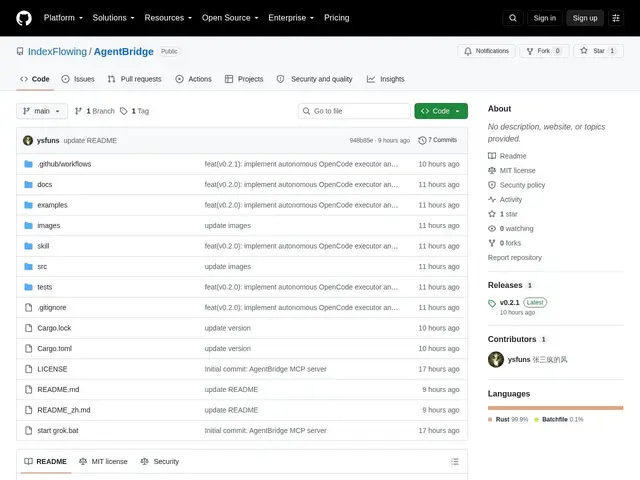
Description
If you've ever wished you could have a sharp, big-picture thinker sketch out a plan on a whiteboard while a fast, focused doer actually builds it, AgentBridge is built around that same split — applied to AI coding assistants. Instead of relying on a single AI to both reason about a hard problem and grind through writing every line of code (which burns through usage limits fast), AgentBridge lets you assign the thinking to one AI (the 'Brain', e.g. a web chat session with Gemini or Claude) and the actual file-editing and test-running to another (the 'Executor', currently OpenCode running locally).
Technically, AgentBridge is a small Rust-based local server (installed via Cargo) that exposes your codebase to the Brain through a read-only Model Context Protocol (MCP) connection — so the Brain can inspect files, check git status and diffs, and draft a plan, without being able to directly modify anything. That plan is then handed to the local Executor agent through AgentBridge's own C2C (Context-to-Context) task protocol, which runs the actual changes. The server listens on localhost only by default (port 8030) and includes safeguards for sensitive file paths. It's an early-stage, MIT-licensed open-source project (a handful of commits so far) with a roadmap toward supporting more Executor backends beyond OpenCode.
💬 Our review
The short version: AgentBridge is a clever, free way to stop burning your best (and often rate-limited) AI's usage on grunt work, by having it plan while a separate local coding agent does the typing — but it's a young, small project you should expect to tinker with.
The read-only MCP bridge for the 'Brain' is a genuinely sound safety idea (the planning AI literally cannot touch your files, only the Executor can), which is more disciplined than just running one all-purpose agent end-to-end. Compared to integrated tools like Claude Code or Cursor, though, AgentBridge is not a polished, all-in-one product — it currently only supports OpenCode as the Executor, you still need and pay for your own AI subscriptions on both sides of the bridge, and with only a handful of commits at review time, expect rough edges and a small community rather than the maturity of Claude Code, Cursor, or Aider. It's free and open source, so there's no direct cost risk in trying it, but the real cost is your time wiring it up and the ongoing bills from whichever Brain and Executor models you choose to pair with it.
💰 Pricing
📊 Global score
🤖 AI-enriched data
Free and open source (MIT). No cost for AgentBridge itself; requires your own paid/free access to the AI models used as Brain and Executor.
Pros
Free and open source (MIT)
Read-only MCP access keeps the planning AI from directly touching files - a real safety boundary
Local-first, localhost-only server by default
Lets you pair a strong reasoning model with a separate execution agent to avoid burning rate-limited quota on grunt work
Cons
Very early-stage project (only a handful of commits at time of review)
Currently only supports OpenCode as the Executor
Still requires and pays for separate AI subscriptions on both sides
No polished UI - CLI/server setup aimed at technical users