Scrapeforge
A web scraper you configure with a YAML file instead of writing custom code, that first checks how hard a site is to scrape and automatically picks the right method.
🔗 Visit Scrapeforge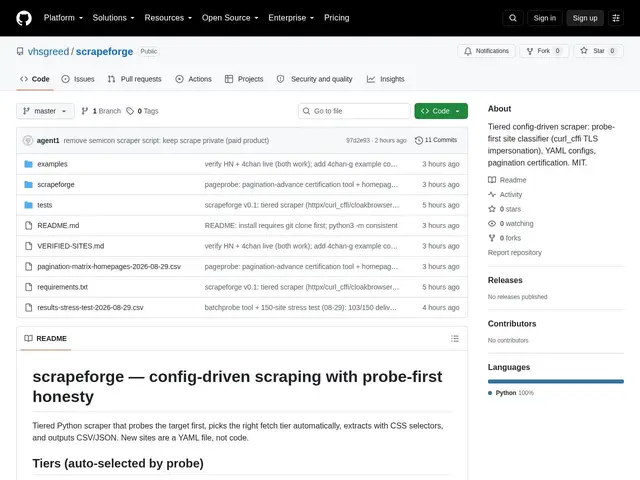
Description
Most web scraping projects start the same frustrating way: write a script for one site, watch it break on the next site because that one needs a real browser instead of a simple HTTP request, then rewrite it again. Scrapeforge tries to remove that guesswork by probing a target site first — checking whether a plain request works, whether it needs to impersonate a real browser's TLS fingerprint, or whether it needs full browser automation — and then using whichever tier actually works, all driven by a YAML config file rather than custom code per site.
Technically, this means a data engineer can point Scrapeforge at a new site, let it classify the site's complexity automatically, and get pagination handling, CSS-selector-based extraction, and CSV/JSON output without writing a scraper from scratch. It's open source under the MIT license and built in Python. It's also very early: at the time of writing it has a handful of commits and no meaningful community adoption yet, so treat it as a promising utility to evaluate rather than a battle-tested tool with years of edge cases already handled.
💬 Our review
The short version: Scrapeforge's core idea — probe first, then escalate fetching strategy automatically — is a genuinely useful pattern that saves the classic scraping trial-and-error, but it's a brand-new, single-maintainer project competing against mature tools with far more real-world mileage.
Established options like Scrapy (for pure HTTP-based crawling at scale) or Playwright (for full browser automation) are more battle-tested, and hosted services like Firecrawl or Apify handle anti-bot measures and proxy rotation as a managed service so you don't maintain the infrastructure yourself. Scrapeforge's pitch is convenience for smaller, config-only jobs where you don't want to write per-site scraper code — that's a real gap for people who aren't already deep in the scraping ecosystem, but you should expect to hit the limits of an early-stage tool (thin anti-bot handling, fewer maintained selectors) faster than with something like Scrapy or a managed API.
💰 Pricing
📊 Global score
🤖 AI-enriched data
Fully open source, MIT licensed, no paid tier.
Pros
Probes site complexity automatically before choosing a fetch strategy
No code required per site — YAML config instead
Three-tier fetching from plain HTTP up to full browser automation
Built-in pagination handling and CSV/JSON export
Free and open source
Cons
Very early-stage project with minimal real-world track record
Single maintainer, no visible community yet
Likely thinner anti-bot/proxy handling than dedicated scraping services
No managed infrastructure — you still run and maintain it yourself