Itsuki
A shared memory service for AI assistants and agents — it remembers facts and context from your conversations across tools like Claude, ChatGPT, and Cursor, instead of each tool starting from zero every time.
🔗 Visit Itsuki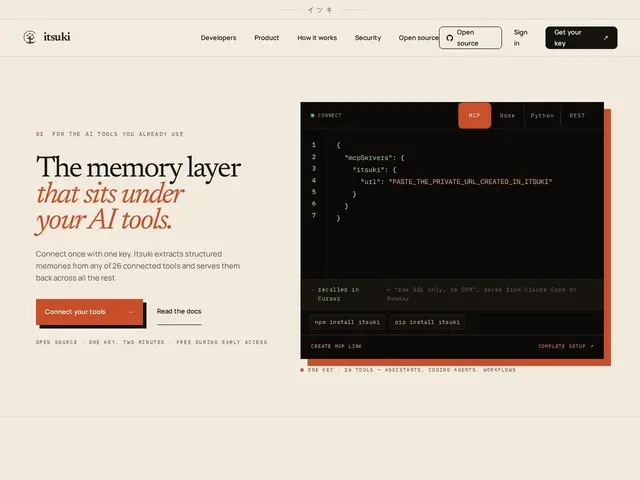
Description
Every AI chat assistant you use — Claude, ChatGPT, Cursor, whatever's next — forgets everything the moment the conversation ends, and none of them share what they learned about you with each other. Itsuki is an attempt to fix that by acting as an external memory that any of those tools can read from and write to: it watches conversations, documents, and events, pulls out durable facts ("this person prefers TypeScript," "this project uses Postgres"), and makes them available the next time you talk to any connected tool.
Technically, it's infrastructure for developers rather than a consumer app: you integrate it via REST API, official SDKs, or the Model Context Protocol (MCP), and it exposes structured memory objects — facts, events, entities, relationships — each linked back to its source with an audit trail, and genuinely deletable (not just hidden) if you need to remove something. It claims connections to 26+ AI tools and frameworks including LangChain and CrewAI, runs on Cloudflare's edge stack (Workers, D1, Durable Objects), and is open source under Apache 2.0. It's in early access with a small usage cap (~100 saves/day) and a genuinely small GitHub following so far, which is typical for infrastructure this early but worth knowing before building critical paths on it.
💬 Our review
The short version: Itsuki is chasing a real and increasingly recognized problem — AI agents having no persistent, shared memory across tools — with a sensible architecture (MCP support, structured objects, source links, real deletion), but it's an early, small project entering a space where a few other memory layers already have more traction and funding.
Projects like Mem0, Zep, and Letta (formerly MemGPT) have been building agent-memory infrastructure for longer and have larger communities, more integrations proven in production, and in some cases commercial backing; Itsuki's differentiator is being fully open source and free during early access, plus explicit source-linking and true delete semantics that some competitors handle less transparently. For a side project or an early-stage product where you want to avoid vendor lock-in and can tolerate rough edges, Itsuki is worth evaluating specifically for its openness. For anything you're shipping to real users today, the safer bet is one of the more established memory layers with a longer production track record, at least until Itsuki's usage caps lift and its ecosystem matures.
💰 Pricing
📊 Global score
🤖 AI-enriched data
Free during early access, roughly 100 saves per day. No paid tier announced yet.
Pros
Single integration point across 26+ AI tools via REST, SDKs, and MCP
Structured memory objects with source links and audit trail
Genuinely deletable memories, not just hidden
Fully open source under Apache 2.0
Free during early access
Cons
Small, early-stage project with limited GitHub traction so far
Usage capped at ~100 saves/day in early access
Less production track record than established memory-layer competitors
No committed pricing model once early access ends