Spanlens
Observability tool for apps built on LLMs — swap in one URL and it starts logging every AI call, tracking what it costs, and tracing multi-step agent workflows across OpenAI, Anthropic, Gemini and more.
🔗 Visit Spanlens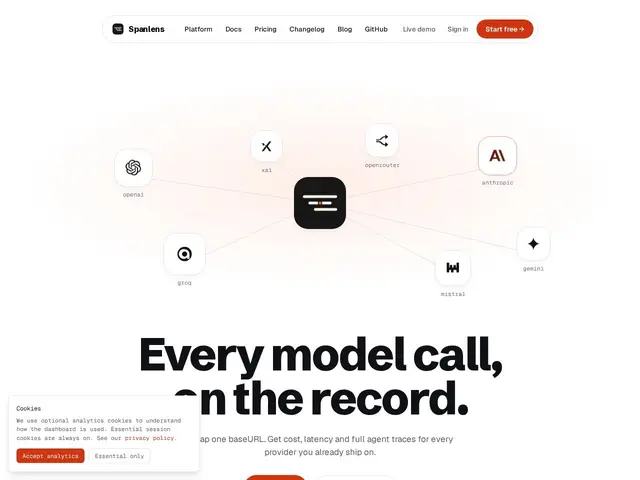
Description
If your app calls an AI model, you eventually hit the same wall every team hits: you have no idea which feature is burning your API budget, why a specific agent run failed three steps in, or whether a user's private data accidentally ended up in a prompt log. Spanlens is built to answer exactly those questions — it sits between your code and the AI provider, watching every request go by, without you needing to rewrite how you call the model.
Technically, integration is a single baseURL swap that routes calls through Spanlens instead of directly to the provider, supporting 10+ providers including OpenAI, Anthropic, Gemini, Groq, Mistral, and xAI. From there it gives you per-model cost tracking with live spend analytics (and doesn't bill you again for cache hits), visualizes multi-step agent workflows as nested trace spans so you can see exactly where a chain of tool calls went wrong, supports OpenTelemetry (OTLP/HTTP) for plugging into existing observability stacks, and includes built-in eval grading you can wire into CI/CD to catch regressions before they ship. It also flags anomalies and potential PII in logged requests, though how reliable that PII detection is in practice isn't independently verified yet.
💬 Our review
The short version: Spanlens covers the right feature set for LLM observability — cost, tracing, evals, PII flagging — with a genuinely low-friction one-line integration, but it's entering an already crowded field against Langfuse, Helicone, and LangSmith, and its free tier's 14-day retention will push serious users toward paying quickly.
💰 Pricing
📊 Global score
🤖 AI-enriched data
Free tier includes 50K requests/month with 14-day retention; Pro at $29/mo offers 100K requests/month; Team at $149/mo provides 1M requests/month with 365-day retention; self-hosted deployment is free with unlimited requests.
Pros
Single baseURL-swap integration, minimal code changes required
Supports 10+ AI providers, not locked to one vendor
Per-model cost tracking with cache-hit billing exemption
Nested-span agent trace visualization for debugging multi-step workflows
OpenTelemetry support for integrating with existing observability stacks
Free, unlimited self-hosted option available
Cons
Free hosted tier's 14-day data retention is short for serious debugging needs
New entrant competing against mature, well-known tools like Langfuse and LangSmith
PII detection and masking accuracy is not independently verified
Hosted free tier capped at 50K requests/month, low for production workloads
Limited public documentation on custom evaluation metrics and advanced tracing scenarios