Alarik
Open-source, self-hosted object storage that speaks the same S3 API as Amazon's cloud storage, so existing tools and scripts work unchanged while your files stay on your own servers.
🔗 Visit Alarik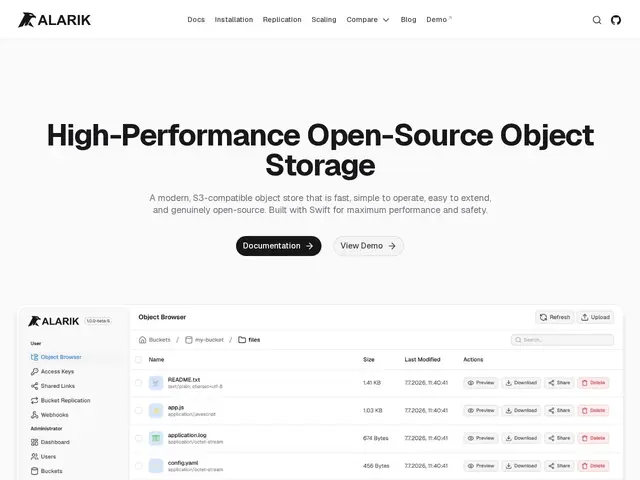
Description
Object storage is the thing behind the scenes that holds every file your app uploads — profile pictures, PDFs, video, backups — and most companies just rent it from Amazon S3. Alarik lets you run that same kind of storage yourself, on your own hardware, while speaking the identical S3 API, so tools like the AWS SDK, s3cmd, or rclone keep working exactly as if you were still pointed at Amazon, minus the cloud bill and the vendor lock-in.
Technically, it's Apache 2.0-licensed and written in Swift, a language choice the project leans on specifically for memory safety — it aims to avoid the buffer-overflow and use-after-free bug classes that have historically plagued storage systems written in C/C++. It ships with a built-in web console for managing buckets and objects, and it's designed to scale horizontally from a single node up to a sharded cluster (cluster coordination currently relies on an external PostgreSQL database). It's explicitly positioned as an open alternative to running AWS S3 directly or self-hosting MinIO, and the project itself describes its current state as beta rather than production-hardened.
💬 Our review
The short version: Alarik is a technically interesting, genuinely open S3-compatible storage option worth watching if you like the idea of a memory-safe alternative to MinIO, but it's beta software from a young project and MinIO remains the far safer default for anyone who needs self-hosted object storage in production today.
💰 Pricing
📊 Global score
🤖 AI-enriched data
Apache 2.0 licensed open-source project with no commercial tiers, enterprise support plans, or SLAs.
Pros
Full S3 API compatibility — drop-in for existing SDKs and tools
Apache 2.0 license with no vendor lock-in
Written in Swift for memory-safety guarantees
Built-in web console included out of the box
Scales from single-node to a sharded cluster
Cons
Currently in beta — not yet positioned as production-ready by the project itself
Much smaller community and battle-testing than MinIO
Cluster mode depends on an external PostgreSQL dependency
No official commercial support plans or SLAs
Fewer third-party integrations and operational tooling than mature alternatives