Warren - Cloud Infrastructure Platform
Warren is a managed platform that lets service providers and enterprises run their own public or private cloud, combining KVM/QEMU compute, Ceph storage, SDN, billing, and self-service under one control plane.
🔗 Visit Warren - Cloud Infrastructure Platform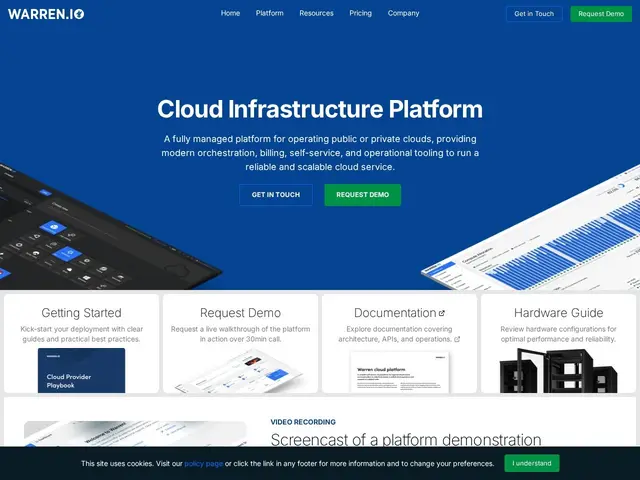
Description
Imagine your company could stop renting server space from Amazon, Google, or Microsoft and instead become its own cloud provider — running the same kind of always-on, scalable, self-service infrastructure internally, or even reselling it to others. That's what Warren does: it's a software platform that turns a stack of physical servers into a private (or public) cloud that behaves like a mini-AWS, complete with self-service dashboards, automatic billing, and the operational tooling needed to run it reliably.
Under the hood, Warren acts as a unifying control plane that orchestrates compute, storage, and networking as one coordinated system rather than a pile of separately-managed tools. Compute workloads run on KVM/QEMU hypervisors, storage is handled through distributed Ceph clusters for resilience and scale, and networking is software-defined via OpenSDN/Tungsten Fabric. On top of this infrastructure layer, Warren adds metering and billing engines, zero-trust operator access through Teleport, and a cadence of bimonthly platform updates, targeting compliance profiles like PCI-DSS and ISO 27001 for regulated or enterprise cloud operators.
💬 Our review
The short version: Warren is a solid, if niche, alternative to hand-rolling your own cloud stack on top of OpenStack or Proxmox — it bundles compute, storage, networking, and billing into one managed control plane, but it's built for cloud operators and enterprises, not individual developers, and you won't find a price on the website.
Technically, Warren competes in the same space as OpenStack (the open-source incumbent), Proxmox VE (the budget-friendly favorite for SMBs and homelabs), Platform9 (managed OpenStack/Kubernetes), and VMware Cloud Director (the legacy enterprise choice now destabilized by Broadcom's licensing changes). Warren's pitch is that it pre-integrates the pieces teams usually have to stitch together themselves — KVM/QEMU, Ceph, and Tungsten Fabric SDN — behind a single control plane with billing and self-service baked in, which is a real time-to-market advantage for regional cloud providers who don't want to build an OpenStack team from scratch. The 99.95% SLA, PCI-DSS/ISO 27001 readiness, and named customers (IDCloudHost, ReadyIDC, Pilvio) suggest this isn't vaporware. That said, the usage-based/revenue-share pricing model is opaque by design — there's no public price list, so you can't comparison-shop the way you can with Proxmox (largely free) or even Platform9's more transparent tiers, and 'contact us for a partnership' pricing structures tend to favor the vendor in negotiations. It's also a much smaller, less battle-tested ecosystem than OpenStack, with a thinner community and fewer third-party integrations. Worth evaluating if you're a hosting provider or enterprise that wants a managed alternative to building your own cloud stack; not relevant if you're an individual developer or small team looking for cheap self-hosted virtualization — Proxmox will serve you better and cheaper.
💰 Pricing
📊 Global score
🤖 AI-enriched data
Usage-based partnership model with no setup, license, or minimum fees; pricing options include revenue share, capacity-based fees, or growth discounts. No public price list — requires contacting sales.
Pros
Unified control plane for compute, storage, networking, and billing
Pre-integrated KVM/QEMU + Ceph + Tungsten Fabric stack
99.95% uptime SLA
PCI-DSS and ISO 27001 readiness
Demonstrated customers (IDCloudHost, ReadyIDC, Pilvio)
Cons
No public pricing — opaque 'contact us' model
Small ecosystem and community compared to OpenStack
Not suited for individual developers or small-scale self-hosting
Vendor lock-in risk with revenue-share partnership terms