OctoStream
Turns RTSP/RTMP camera feeds into an embeddable web player (HLS) and restreams them simultaneously to YouTube, Twitch, Facebook and Instagram.
🔗 Visit OctoStream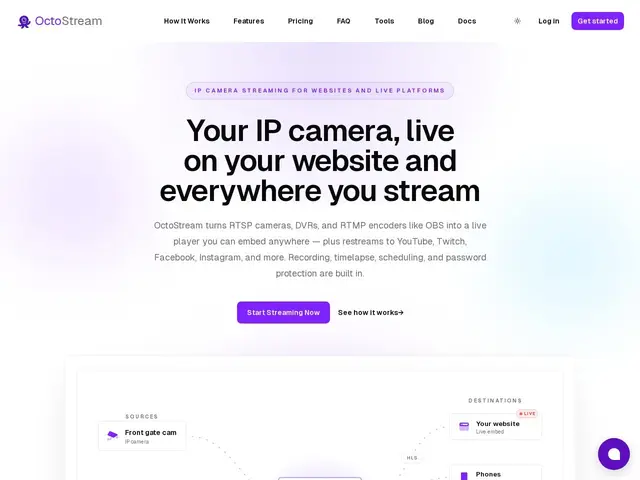
Description
Plenty of businesses have a security camera pointed at something people actually want to watch — a beach, a construction site, a church service, a resort view — but getting that raw camera feed onto a website in a way any visitor can watch, on any device, without installing anything, is a real technical hurdle. OctoStream exists to remove that hurdle: point it at your camera, and it turns the feed into a normal video player you can drop into any webpage.
Technically, OctoStream ingests RTSP camera streams, DVR/NVR outputs, and RTMP encoders (like OBS) and converts them to HLS, a format that plays natively in any modern browser with no plugins or apps. Beyond embedding, it can simultaneously restream the same feed to YouTube, Twitch, Facebook and Instagram, and adds practical extras: cloud recording with day-by-day playback, scheduled on/off streaming windows, password-protected and domain-locked embeds, timelapse generation from snapshots, and a branded player. Pricing is tiered by camera count, from a free plan (1 camera, 100 MB/day) up to $199.99/month for 15 cameras, with documented setup guides for common camera brands like Reolink.
💬 Our review
The short version: if you already have an IP camera and just want its feed watchable on your website without hiring a video engineer, OctoStream does exactly that one job cleanly — it's not trying to be a full video platform.
Compared to general live-streaming platforms like Mux or Cloudflare Stream, OctoStream is narrower but far simpler to set up for this specific use case: point an RTSP/RTMP source at it, get an embed code, done — no need to build your own player or transcoding pipeline. Compared to just restreaming manually to YouTube Live, OctoStream's advantage is the simultaneous multi-platform restream plus a real embeddable player for your own site, which YouTube alone doesn't give you. The free tier (1 camera, 100 MB/day) is genuinely usable for testing or a low-traffic embed, and the paid tiers scale sensibly by camera count rather than bandwidth tricks. Where it's weaker: at $199.99/month for 15 cameras, a resort or facilities company with a lot of feeds will pay meaningfully more than a self-hosted alternative built on something like MediaMTX — but self-hosting means owning the infrastructure and support yourself. Worth it if you want a reliable, done-for-you camera-to-web pipeline; skip it if you already have in-house streaming infrastructure or only need a single feed occasionally.
💰 Pricing
📊 Global score
🤖 AI-enriched data
Gratuit (1 camera, 100 Mo/jour), Starter 9,99$/mois (2 cameras), Plus 29,99$/mois (5), Pro 59,99$/mois (10), Max 199,99$/mois (15 cameras).
Pros
Mise en place tres simple : pas de pipeline video a construire soi-meme
Restream simultane vers YouTube, Twitch, Facebook, Instagram
Palier gratuit reellement utilisable pour tester
Cons
Tarif qui grimpe vite au-dela de quelques cameras (199,99$/mois pour 15)
Moins de controle qu'une infra self-hosted (ex. MediaMTX)
Pensé pour la diffusion camera, pas pour du streaming video generaliste