Defragger
A graphical disk defragmentation tool for Linux that visualizes fragmented files as block maps and lets you defragment ext4 files or offline FAT volumes.
🔗 Visit Defragger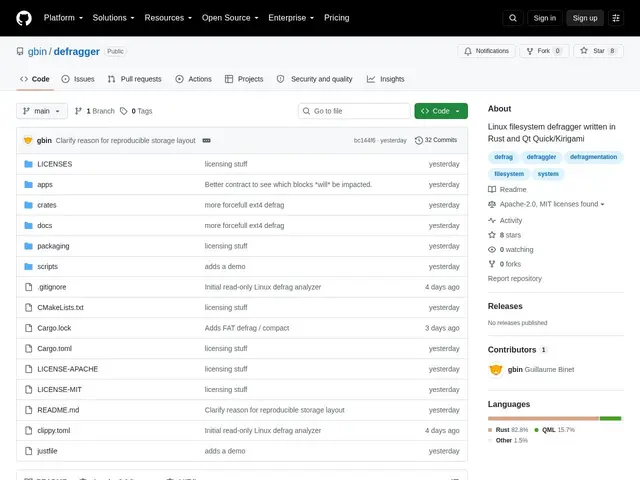
Description
Linux users have mostly been told for years that 'defragmentation doesn't matter on Linux,' and for typical desktop use that's largely true — but it's not true for storage-heavy workloads like high-throughput logging, where a genuinely fragmented file can measurably hurt read/write performance in ways that are hard to reproduce or debug without a way to see it happening. Defragger fills that specific, narrow gap: a real graphical defragmenter for Linux, something that barely exists as a category on this OS.
It renders an adaptive block map of a filesystem so you can visually see how a file's data is scattered across disk, and can defragment individual ext4 files as well as fully defragment or compact offline FAT16/FAT32 volumes. It runs with PolicyKit-based privilege separation (so it doesn't need to run entirely as root), supports safe cancellation mid-operation with progress reporting, and can analyze ext4, FAT, and exFAT filesystems even where it can't fully defragment them. It's dual-licensed MIT/Apache 2.0 and fully open source.
💬 Our review
The short version: a niche but honestly useful tool if you actually have a fragmentation problem on Linux (which is rarer than on Windows, but real for specific workloads) — command-line alternatives like e4defrag exist, but nothing else gives you the same visual block map to actually see what's happening.
Its value is almost entirely about visibility: e4defrag can defragment an ext4 file blindly, but Defragger lets you see the fragmentation before and after, which is genuinely useful for diagnosing performance issues on logging-heavy or database-heavy systems. The honest caveat is that this solves a problem most Linux desktop users simply don't have — modern filesystems and SSDs make fragmentation far less impactful than it was on spinning disks — so treat it as a specialized diagnostic/ops tool rather than something to run routinely, and as a small open-source project it won't have the polish or safety guarantees of built-in filesystem tooling.
💰 Pricing
📊 Global score
🤖 AI-enriched data
Open source, double licence MIT/Apache 2.0.
Pros
Visualisation graphique de la fragmentation (carte de blocs)
Défragmentation de fichiers ext4 et de volumes FAT16/FAT32 hors-ligne
Séparation des privilèges via PolicyKit, pas besoin de root complet
Gratuit et open source
Cons
Utile seulement pour des cas de fragmentation réels (rares sur Linux/SSD modernes)
Alternatives en ligne de commande (e4defrag) existent déjà pour le cas ext4 simple
Petit projet, pas les garanties d'un outil intégré au système