FERAL
A local-first AI assistant that runs entirely on your machine, remembers context across apps and devices, and only acts with your explicit approval.
🔗 Visit FERAL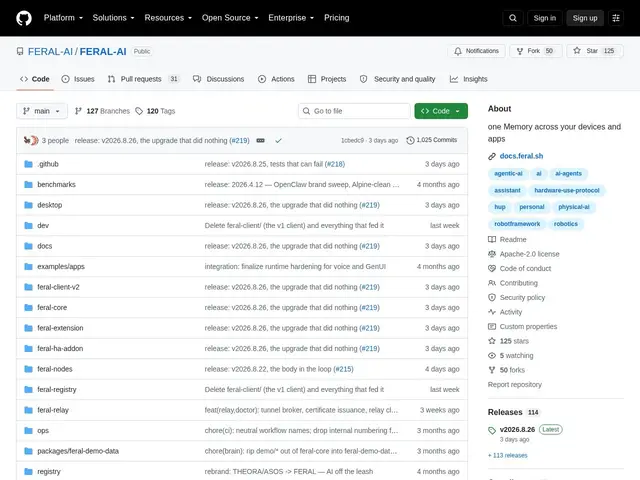
Description
Most AI assistants live in the cloud: your data leaves your computer, gets processed by someone else's servers, and the assistant forgets everything the moment you close the tab. FERAL flips that around — it's a personal AI that runs on your own Mac or Linux machine, remembers what you've told it over weeks and months, and only takes an action (like sending a message or changing a file) after you've explicitly allowed it to. Think of it less like a chatbot and more like a live-in assistant that actually knows your habits, but never does anything behind your back.
Technically, FERAL is an open-source (Apache 2.0), local-first orchestration layer that connects multiple LLM providers (OpenAI, Anthropic, Gemini, Groq, DeepSeek, or fully local models via Ollama/LM Studio) to a persistent multi-layer memory system: working context for the current task, episodic logs of past events, a semantic graph for long-term retrieval, and a full execution history. It also learns a rolling behavioral baseline (metrics, anomaly/trend detection) and gates every real-world action behind explicit policy approvals and daily caps, with a community extension registry and phone pairing (Wi-Fi or Tailscale) for remote control.
💬 Our review
The short version: if you want an AI agent you fully control and that never phones home with your data, FERAL is one of the more serious attempts at that — but it's early, self-hosted, and asks you to do the ops work a cloud assistant would otherwise hide from you.
FERAL's real differentiator is the combination of local-first execution, a genuinely multi-layered memory model (not just a chat log), and hard policy gates before it takes any action — that's a meaningfully more cautious design than most 'autonomous agent' projects that ship with broad, always-on permissions. Provider-agnostic LLM support is also a real plus: you're not locked into one vendor, and you can run it fully offline with local models if you want zero external calls at all. The trade-offs are what you'd expect from a young, self-hosted, single-maintainer-scale project: no managed hosting, no formal support, a smaller extension ecosystem than an established assistant platform, and you're responsible for keeping the memory store, approvals, and any exposed services (like phone pairing) properly secured yourself.
💰 Pricing
📊 Global score
🤖 AI-enriched data
Open source sous licence Apache 2.0, auto-hébergé, aucune offre commerciale.
Pros
100% local-first — aucune donnée n'est envoyée à un tiers par défaut
Mémoire multi-couches (contexte, historique, graphe sémantique, exécution)
Actions réelles bloquées derrière des approbations de politique explicites
Agnostique au fournisseur LLM (cloud ou modèles locaux via Ollama/LM Studio)
Cons
Auto-hébergement = maintenance et sécurité à la charge de l'utilisateur
Projet jeune, écosystème d'extensions encore restreint
Pas de support commercial ni d'hébergement managé