Rudder
A local plugin that retroactively generates specifications and linked unit tests from your AI coding agent's prompt history.
🔗 Visit Rudder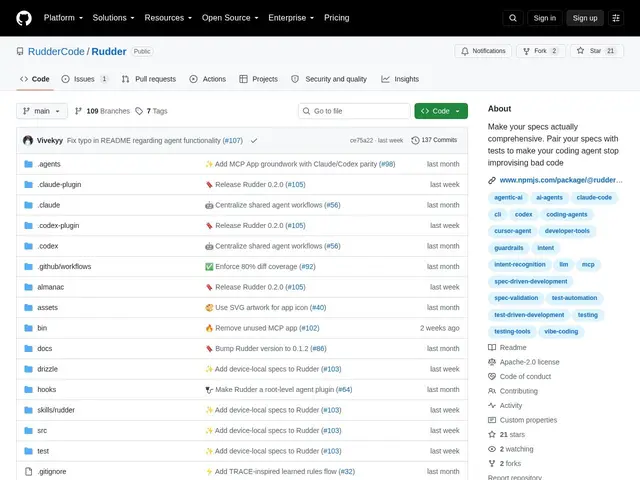
Description
AI coding assistants are only as good as the instructions you give them — and most people never write those instructions down, they just type prompts and hope. Rudder works backwards from that problem: it looks at the history of what you actually asked your AI coding agent (Claude Code, Codex) to do, and retroactively writes a proper specification from it, then generates unit tests that check the code actually meets that spec.
It's aimed at teams practicing spec-driven development who want a paper trail proving their AI-written code does what was asked, not just what compiled. Everything — the prompt history, the generated specs, the test-to-spec mapping — is stored locally in SQLite and never sent anywhere, and it's designed to plug into any coding agent rather than being locked to one vendor. It's free and open source under the Apache 2.0 license.
💬 Our review
The short version: a smart, narrow tool for a specific pain point — if you're already using AI coding agents heavily and worried that nobody can say what the code was actually supposed to do, Rudder gives you a spec after the fact instead of making you write one before.
Test coverage tied to specification completeness is a clever proxy metric, though it's still a proxy — 100% test coverage of a poorly-inferred spec doesn't guarantee the spec matches what you actually wanted. There's no direct competitor doing retrospective spec generation quite this way; the closer comparisons are spec-first tools (like AWS Kiro) that make you write the spec upfront, or plain test-coverage tools that skip the specification step entirely. Being free, open source, and fully local makes it low-risk to try if you're already deep in an AI-assisted workflow.
💰 Pricing
📊 Global score
🤖 AI-enriched data
Open source sous licence Apache 2.0, aucun coût.
Pros
Génère des specs à partir de l'historique réel de prompts
100% local, stockage SQLite, rien n'est envoyé en ligne
Compatible avec n'importe quel agent de code
Gratuit et open source (Apache 2.0)
Cons
La couverture de tests comme proxy de complétude reste imparfaite
Utile seulement si vous utilisez déjà un agent IA de code intensivement
La qualité des specs dépend de la qualité des prompts d'origine