openGym
A free, self-hosted gym and body-weight workout tracker that keeps all your training data on your own server instead of a cloud app.
🔗 Visit openGym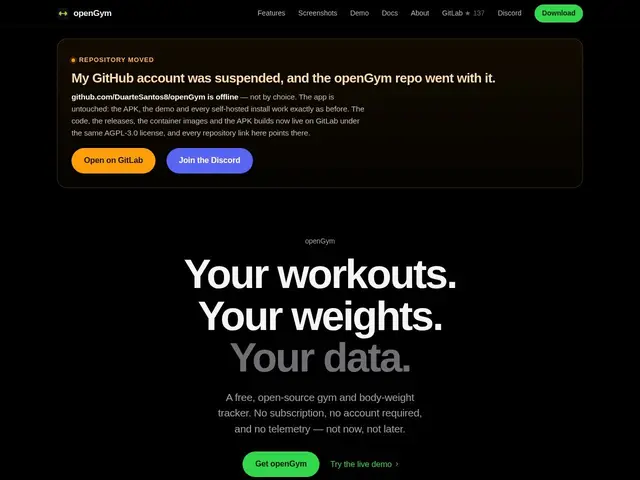
Description
Fitness apps like Strong or Hevy are convenient, but your workout history — years of weights, reps, and progress — ends up locked inside someone else's server and subscription plan. openGym flips that: it's a workout tracker you run yourself, so your training data stays in a folder you control, on hardware you own.
openGym is an open-source, self-hosted gym and body-weight exercise tracker for planning routines, logging workouts (including supersets and cardio), and tracking body weight and progress over time. It runs via a single `docker compose up`, uses passkey (WebAuthn) authentication instead of passwords, and syncs across devices — phone included, via a Capacitor-based mobile build on top of a React frontend and Node.js backend. It's licensed under AGPL-3.0, and while the original GitHub repository went offline, the project's code, releases, and container images now live on GitLab under the same license, with a small but active Discord community.
💬 Our review
The short version: openGym is a solid pick if you specifically want a self-hosted, ad-free, subscription-free workout tracker and don't mind running a Docker container — it's not going to out-feature Strong or Hevy, but it doesn't try to; it trades polish for full data ownership.
Compared to Strong or Hevy, which offer more mature mobile apps, larger exercise libraries, and social features out of the box, openGym is a young project (created August 2026, three GitLab releases so far) run by essentially one maintainer after the original GitHub repo went dark. That's a real availability risk worth weighing if you're trusting it with years of training data — but for anyone already self-hosting other services who wants one more app off a subscription and off someone else's servers, it's a reasonable, free trade.
💰 Pricing
📊 Global score
🤖 AI-enriched data
Gratuit, licence AGPL-3.0, à héberger soi-même (Docker).
Pros
Auto-hébergé : vos données d'entraînement restent chez vous
Authentification par passkey (WebAuthn), pas de mot de passe
Gratuit, sans abonnement ni publicité
Support des supersets et du cardio, synchronisation multi-appareils
Cons
Projet jeune (créé en août 2026), un seul mainteneur principal
Le dépôt GitHub d'origine est hors ligne, code déplacé sur GitLab
Moins de fonctionnalités et de finition qu'une app comme Strong ou Hevy
Demande de savoir faire tourner Docker soi-même