Retriever AI
Browser automation agent that handles web tasks via natural language, from lead enrichment to data extraction, with cloud scaling and API integration.
🔗 Visit Retriever AI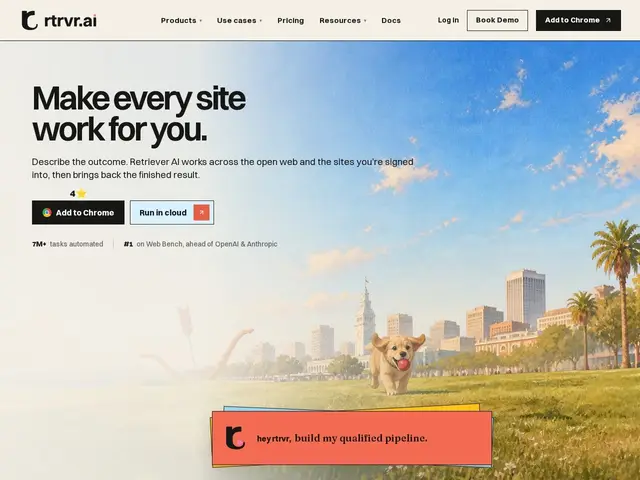
Description
Retriever AI is a digital assistant that browses the web for you, the way you'd ask a very capable intern to fill out a form, gather contact details, or pull data from a list of websites while you focus on something else. You describe what you need in plain English — "find me the emails of 50 marketing directors at SaaS companies" — and it clicks through pages, fills fields, and hands back the results. It runs as a free Chrome extension for quick one-off jobs, or scales up in the cloud when a task needs to run thousands of times at once.
Under the hood, Retriever AI is a browser automation agent trained on more than 7 million real automation runs, claiming an 81.4% success rate on Web Bench benchmarks at roughly $0.005 and 0.9 minutes per task on average. It exposes an API and MCP (Model Context Protocol) support so developers can trigger jobs programmatically, chain them into pipelines, or plug in their own AI provider instead of the built-in model. The cloud platform can spin up more than 1,000 concurrent browser instances, and features include lead enrichment, data extraction, form filling, social media automation, scheduled runs, webhook triggers, and cookie/session syncing between the extension and cloud browsers. Pricing runs on a pay-per-task credit system: 1 credit equals 1 cent.
💬 Our review
The short version: Retriever AI is a genuinely capable browser agent for people who'd rather type a sentence than write a scraper, but the free tier's sponsored result cards and credit-metered pricing mean casual users hit limits fast, and heavy users need to budget carefully.
At $9.99/month for 1,000 credits (roughly $0.01 each, close to its claimed $0.005-per-task average), Retriever AI undercuts Clay's lead-heavy per-credit pricing but sits above pure scraping infrastructure like Apify (free tier plus usage-based compute) or Firecrawl ($0.002-$0.015 per scrape credit). Compared to Bardeen and Browser Use, which focus narrowly on no-code workflow triggers, Retriever AI's MCP support and bring-your-own-AI option make it more developer-friendly, while Browserbase is the better pick if you just need raw headless browser infrastructure rather than an agent that decides what to click. At $499.99/month for 50,000 credits, the Scale tier is steep unless you're running genuinely enterprise-volume jobs — for most teams, Starter or a mid-tier plan will do.
💰 Pricing
📊 Global score
🤖 AI-enriched data
Version gratuite avec 250 crédits de bienvenue (sans CB requise) et cartes sponsorisées affichées avec les résultats ; extension Chrome gratuite ; plans payants de 9,99 $/mois (Starter, 1 000 crédits) à 499,99 $/mois (Scale, 50 000 crédits) ; facturation à la tâche, 1 crédit = 1 cent.
Pros
Langage naturel : décrire la tâche en une phrase suffit, pas besoin de coder un scraper
Scalabilité cloud avec plus de 1 000 instances de navigateur simultanées
Intégration API et support MCP pour brancher l'agent dans des pipelines existants
Taux de réussite revendiqué de 81,4% sur les benchmarks Web Bench, à faible coût par tâche
Cons
Palier gratuit financé par des cartes sponsorisées affichées dans les résultats — pas totalement neutre
Modèle au crédit qui peut vite grimper pour un usage intensif (jusqu'à 499,99 $/mois)
Automatisation de navigateur intrinsèquement fragile face aux changements de structure des sites
Dépendance à l'extension Chrome pour l'usage gratuit — pas d'équivalent Firefox/Safari mentionné