Orchesty
Open-source streaming-first integration platform for building scalable asynchronous workflows and orchestrating APIs with AI agent support.
🔗 Visit Orchesty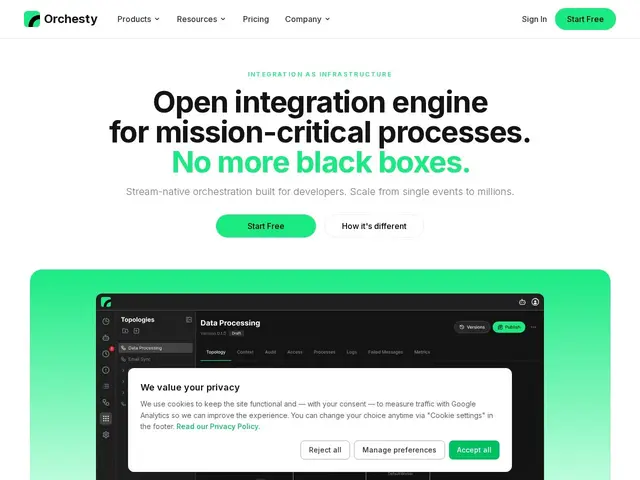
Description
If your business needs to move data between dozens of tools and APIs — and that traffic is not a handful of daily updates but thousands or millions of events pouring in every day — regular point-to-point integrations tend to break down under the load. Orchesty is a platform built specifically for that scale problem: it lets developers wire systems and APIs together into automated workflows that keep running reliably under heavy, continuous traffic, with built-in retry logic so a single failed step does not mean lost data.
Under the hood, Orchesty is a streaming-first integration engine with Node.js and PHP SDKs for building custom connectors, plus a library of 100+ pre-built ones. Workflows support per-message persistence with automatic retry, per-node scaling, and rate limiting, so throughput can be tuned node by node instead of for the whole pipeline. It ships with an MCP (Model Context Protocol) integration for orchestrating AI agents, an AI Bootstrap feature that auto-generates connectors, and real-time observability with audit trails and a trace-auditing assistant. Deployment is flexible — cloud, private, or fully on-premise — with Kubernetes support via Helm charts, and the core is commercial open-source under the Elastic License, offered as a free Community Edition or a paid Enterprise edition.
💬 Our review
The short version: Orchesty is a solid pick if you're a developer team drowning in high-volume, mission-critical integrations and want self-hosted control down to the Kubernetes level — but it's overkill, and arguably too code-heavy, for anyone who just wants to connect a form to a spreadsheet.
Compared to n8n, Zapier, or Make, Orchesty plays a different game: those tools optimize for fast, visual, low-code automation that non-developers can build in minutes, while Orchesty is infrastructure — built for streaming architectures, per-node scaling, and volumes those tools were never designed to sustain gracefully. That focus comes with trade-offs worth knowing before committing: the core is PHP under the Elastic License, which is source-available rather than truly open source (only the Node.js/PHP SDKs are Apache-2.0), and the main GitHub repo currently sits at just 2 stars, a sign this is still an early, largely unproven project rather than a battle-tested standard like its rivals.
💰 Pricing
📊 Global score
🤖 AI-enriched data
Palier gratuit (Community Edition) disponible ; édition Enterprise sur devis auprès de l'équipe commerciale.
Pros
Conçu pour le streaming et les très gros volumes (jusqu'à des millions de messages/jour)
Persistance par message avec retry automatique en cas d'échec
Scaling par nœud et limitation de débit configurables finement
Support Kubernetes natif (Helm charts) + déploiement cloud, privé ou on-premise
Cons
Cœur sous licence Elastic (source-available), pas open source au sens strict — seuls les SDK sont Apache-2.0
Adoption GitHub encore très faible (2 stars sur le repo principal), projet jeune et peu éprouvé
Courbe d'apprentissage plus technique que n8n/Zapier/Make, orienté développeurs
Moins adapté aux utilisateurs non-techniques cherchant de l'automatisation simple sans code