Openspender
Self-custodial wallet system that enables AI agents to make autonomous payments for services while maintaining user control over funds via USDC on Base blockchain.
🔗 Visit Openspender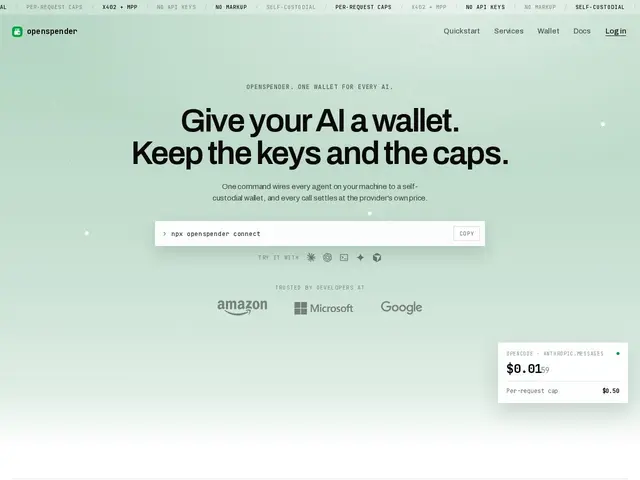
Description
Picture handing a group of interns a single prepaid card instead of your personal credit card, with a strict daily limit and a receipt for every purchase — that's roughly what Openspender does for AI agents. When an AI assistant like Claude or ChatGPT needs to pay for a web search, an image generation, or some other paid API on the fly, it doesn't need your actual bank details or a separate account with every provider. It draws from one wallet you fund and control, spends only within limits you set, and logs every transaction so you always know where the money went.
Under the hood, Openspender is a self-custodial wallet built on USDC over the Base blockchain, implementing the HTTP 402 'Payment Required' status and the Machine-Payable Protocol (MPP) so agents can transact with any compliant endpoint without manual account setup. It currently routes to over 15,171 x402 endpoints and 141 MPP services, passing requests through unchanged so pricing stays whatever the provider charges — no markup. Developers integrate it via an NPM package (npx openspender connect), manual SDK/curl config, or MCP support for Claude, ChatGPT, Cursor, and Gemini. Spending is bounded per-request, daily, and in total, and the system fails safe: unknown routes return 404, ambiguous ones 409.
💬 Our review
The short version: Openspender solves a real problem — letting AI agents pay for services without scattering API keys everywhere — and its spending-cap design is genuinely reassuring. But it's early-stage, handles real money, and has no visible ownership, which should give anyone pause.
Pricing is fair on paper — pay-as-you-go with no markup, so a Claude message can cost fractions of a cent and a search a cent or two, with no subscription lock-in. The catch is trust: there's no creator or company name anywhere on the site, no GitHub repository to audit the code, and the underlying ecosystem (12,841+ indexed services) is still young and unproven at scale. For a tool that custodies a wallet funding real USDC transactions, that combination of anonymity and immaturity is a legitimate risk, not just a rough edge — treat it as an experiment, not infrastructure to bet a business on yet.
💰 Pricing
📊 Global score
🤖 AI-enriched data
Aucun abonnement : facturation à l'usage sans majoration, au tarif de chaque fournisseur. Exemples : Claude à partir de 0,001 $ par message, recherche Exa à 0,007 $ la requête, recherche Tavily à 0,01 $ la recherche, génération d'image FLUX à 0,003 $ l'image. Certains services (29 modèles BlockRun) offrent un accès gratuit.
Pros
Un seul portefeuille pour piloter plusieurs agents IA, sans multiplier les comptes fournisseurs
Plafonds de dépense configurables par requête, par jour et au total
Facturation à l'usage sans majoration ni abonnement mensuel
Grand livre détaillé (ledger) qui trace chaque transaction
Cons
Aucune attribution visible : ni créateur, ni société identifiée sur le site
Pas de dépôt GitHub public pour auditer le code
Écosystème encore jeune (12 841+ services indexés) et non éprouvé à grande échelle
Confier un portefeuille en USDC à un service anonyme reste un vrai risque financier