Orion
A Rust-compiled backend and automation language with clean syntax, optional typing, native OOP, and 58 built-in modules.
🔗 Visit Orion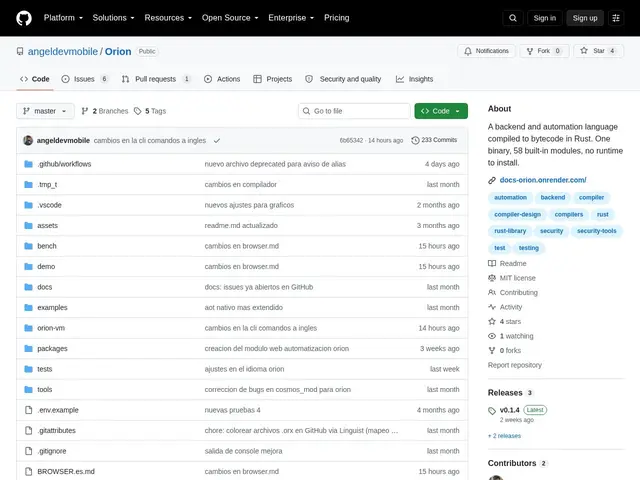
Description
Orion is a new programming language built for people who write backend code and automation scripts — the kind of small APIs, data-processing jobs, or server tools that many developers currently reach for Python to build. The pitch is simple: keep Python's easy-to-read syntax, but compile the code so it starts up almost instantly and runs as a single standalone program with nothing extra to install. It's aimed at developers who like Python's simplicity but want faster, more predictable performance without dragging in a whole runtime environment or a pile of dependencies just to ship a small tool.
Orion is written entirely in Rust, from lexer to virtual machine, and compiles to bytecode that can run through a VM, JIT, or AOT backend. It ships with 58 built-in modules, native OOP based on shapes and composition rather than classical inheritance, async/await concurrency, and a native HTTP server with declarative routing — enough to build an API without external frameworks. Memory is managed with a mark-and-sweep garbage collector, typing is optional, and startup time is sub-millisecond thanks to ahead-of-time compilation. It also bakes in experimental AI-oriented keywords (think/learn/sense) as language primitives, an unusual design choice for a general-purpose backend language.
💬 Our review
The short version: Orion is a technically ambitious solo project — a from-scratch Rust-built language with real compiler internals and genuinely interesting ideas — but it's a one-person, 4-star repository with essentially no users, docs ecosystem, or community, so treat it as a fun experiment to read, not something to build on.
Built by a single developer (Angel Zapata) across 233 commits in 2025-2026, Orion is architecturally serious — a real Rust-written compiler pipeline with VM/JIT/AOT backends, 58 modules, and its own OOP model — which is more engineering than most hobby languages ever get. But a programming language lives or dies by its ecosystem: package registry, third-party libraries, tooling, Stack Overflow answers, hiring pool. Orion has none of that yet, only 4 GitHub stars, and no signs of external contributors. That's not a knock on the code, but it means picking Orion for anything beyond a personal experiment means betting entirely on one maintainer's continued interest, with no community safety net if the project stalls.
💰 Pricing
📊 Global score
🤖 AI-enriched data
Gratuit, licence MIT.
Pros
Compilation native ultra-rapide au démarrage (sub-milliseconde)
58 modules intégrés couvrant un large éventail de besoins backend
Syntaxe proche de Python, facile à apprendre, avec typage optionnel
Déploiement en binaire unique, sans dépendance externe
Cons
Écosystème et communauté quasi inexistants (4 stars GitHub)
Projet développé par une seule personne, aucun contributeur externe visible
Pas de gestionnaire de paquets ni de bibliothèques tierces établies
Trop jeune pour un usage en production, documentation limitée