Anvil
A proxy that translates GitHub API calls to Forgejo, enabling GitHub-compatible tools to work with self-hosted Forgejo instances without modification.
🔗 Visit Anvil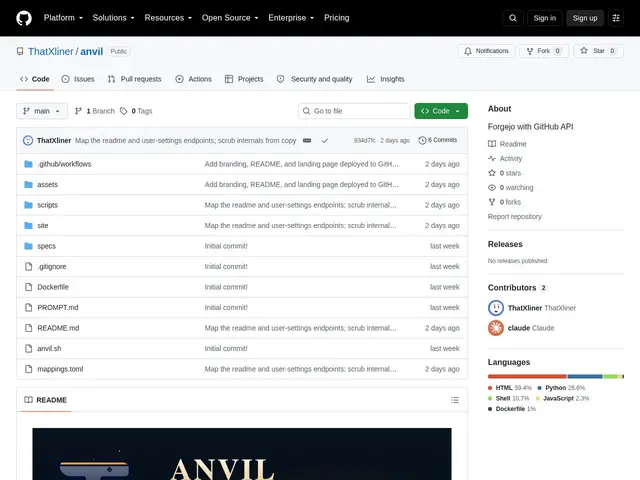
Description
If your team runs its own self-hosted Git server using Forgejo (a free, open-source alternative to GitHub), you've probably hit a wall: most of the developer tools you already rely on — command-line clients, dependency update bots, CI scripts — were built to talk to GitHub's API, not Forgejo's. Rewriting all of that plumbing is a lot of unpaid work just to keep using the tools you like. Anvil sits in between as a translator: it makes a self-hosted Forgejo instance answer like GitHub, so those existing tools keep working without anyone touching their code.
Under the hood, Anvil is a proxy built on Shotgun, an OpenAPI-to-OpenAPI translation engine, and currently maps 75 of GitHub's 87 relevant API endpoints (about 86% coverage), covering users, repositories, branches, issues, pull requests, commit statuses, file contents, README rendering, labels, milestones, releases, webhooks, collaborators, Actions, search, and pagination. It has been tested against the gh CLI and Renovate, and is meant to slot into existing CI/CD scripts. Building it requires a Rust toolchain to compile the underlying Shotgun dependency, and deploying it for real use requires putting a reverse proxy such as Caddy or nginx in front for HTTPS, since gh CLI and most GitHub-compatible tooling expect TLS.
💬 Our review
The short version: a clever, narrowly useful proxy that could save real migration pain for Forgejo self-hosters, but it's a six-commit, zero-star weekend project with no releases and no visible license — treat it as an experiment to poke at, not something to point production CI at yet.
Anvil is early — 0 stars, 0 watchers, 6 commits, no tagged releases, and no license file anywhere in the repo, which legally means you can't safely redistribute or depend on it in a commercial pipeline until that's clarified. The 86% API coverage claim is credible given the endpoint list, and building on Shotgun's OpenAPI-translation approach is a sound architecture rather than a hand-rolled hack. Still, there's no evidence yet of real-world testing beyond gh CLI and Renovate, no CI, and no maintainer track record. Worth watching if you're stuck on Forgejo tooling gaps, worth self-hosting and testing in a sandbox, not worth betting a critical pipeline on today.
💰 Pricing
📊 Global score
🤖 AI-enriched data
Gratuit, mais aucune licence explicite visible sur le dépôt.
Pros
Compatibilité étendue avec l'API GitHub (86 % des endpoints, 75/87)
Fonctionne avec des outils existants comme gh CLI et Renovate sans modification
Architecture solide basée sur Shotgun (traduction OpenAPI-to-OpenAPI)
Évite une réécriture coûteuse des scripts CI/CD lors d'un passage à Forgejo
Cons
Projet très jeune : 0 star, 0 watcher, seulement 6 commits
Aucune release taguée, donc pas de version stable à installer
Aucun fichier de licence visible sur le dépôt, statut légal flou
Nécessite une compilation Rust et un reverse proxy (Caddy/nginx) pour fonctionner en HTTPS