agentty
Single-binary terminal AI coding agent with near-instant startup, working with Claude, GPT, Groq, DeepSeek, or fully local Ollama models.
🔗 Visit agentty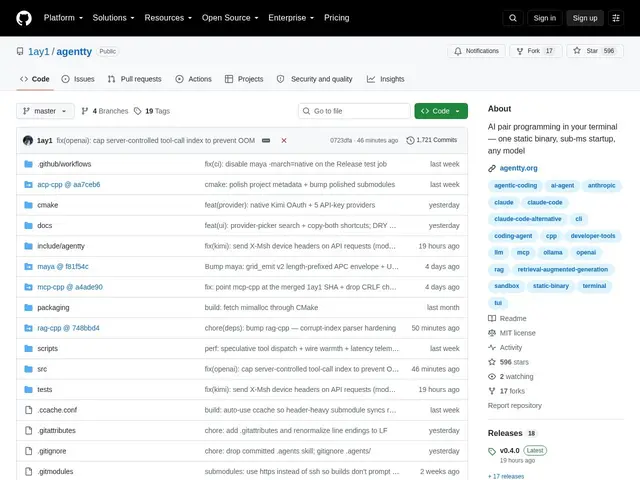
Description
Terminal-based AI coding assistants are usually built on Node.js or Python, which means installing a whole runtime just to get a text-based helper running — and every time you open it, there's a noticeable pause while everything loads. agentty skips all of that: it's one small program you download and run directly, like a tiny app rather than a whole platform, and it opens in about the time it takes to blink.
agentty is an open-source (MIT) terminal AI pair-programming agent written in C++26, shipped as a single static binary (~16.7 MB) with zero runtime dependencies — no Node, no Python, no npm install. Cold start is roughly 3 milliseconds. It supports a wide range of model providers — Anthropic Claude (via OAuth or API key), OpenAI, Groq, DeepSeek, xAI Grok, Google Gemini, Mistral, OpenRouter, Cerebras, Fireworks — plus fully local models through Ollama with no API key at all. Under the hood it includes a local RAG engine combining BM25 keyword search with dense embeddings and GraphRAG for navigating documentation, sandboxed shell execution (bwrap on Linux, sandbox-exec on macOS), a 'Smart Mode' that splits work across strategic/implementation/utility roles, custom skills via .SKILL.md files, and an air-gapped SSH relay mode with TLS pinning for secure remote use. It's actively maintained, with packages for Linux, macOS, Windows, and Android/Termux.
💬 Our review
The short version: agentty is worth a look if you want a terminal coding agent that starts instantly and doesn't lock you into one AI vendor — but it's a smaller, less-established project than the big names.
The single static-binary distribution and sub-millisecond startup are a genuinely different value proposition from Claude Code, Aider, or OpenCode, all of which carry a Node/Python runtime and noticeably slower cold starts. Multi-provider flexibility down to fully offline Ollama use is also a real advantage for anyone who doesn't want to commit to a single vendor's pricing or availability. The catch is ecosystem maturity: at under 600 GitHub stars, it has a fraction of the community, third-party integrations, and battle-testing of Claude Code or Aider, and building from source requires a C++26 toolchain (GCC 14+/Clang/MSVC) — a meaningfully higher bar than `pip install` or `npm install`. On Android specifically, its sandboxed shell execution doesn't work on unrooted devices. For a developer who values speed and vendor independence and is comfortable with a younger tool, it's a compelling pick; for a team that wants the most proven, widely-integrated option, Claude Code or Aider remain safer defaults.
💰 Pricing
📊 Global score
🤖 AI-enriched data
Binaire gratuit sous licence MIT ; nécessite vos propres clés API de fournisseur IA (facturées séparément) ou fonctionne totalement gratuitement en local via Ollama.
Pros
Binaire statique unique (~16,7 Mo), aucune dépendance runtime (pas de Node/Python)
Démarrage à froid d'environ 3 millisecondes
Multi-fournisseurs : Claude, GPT, Groq, DeepSeek, Grok, Gemini, Mistral, ou Ollama en local sans clé API
RAG local intégré (BM25 + embeddings + GraphRAG) pour naviguer dans la documentation
Gratuit, open source, licence MIT
Cons
Écosystème jeune et restreint (moins de 600 étoiles GitHub) comparé à Claude Code ou Aider
Compilation depuis les sources exige une chaîne d'outils C++26 (GCC 14+/Clang/MSVC)
Exécution shell sandboxée indisponible sur Android non-rooté
Moins d'intégrations tierces que les outils plus établis