Huzzah
Experimental editor where you write persistent pseudocode instead of prompts, and the AI regenerates only the code affected by each change.
🔗 Visit Huzzah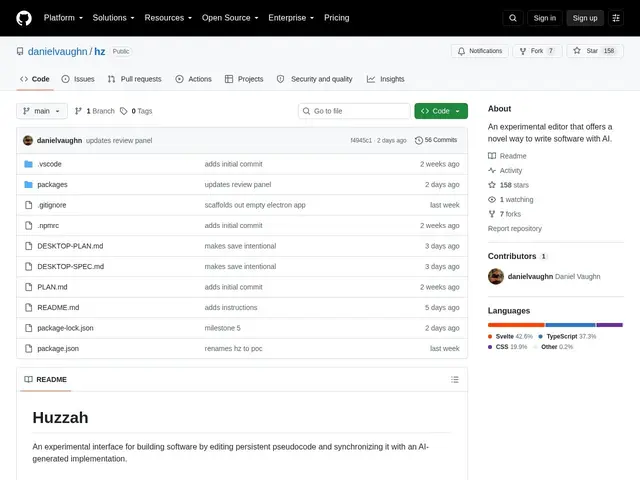
Description
Most AI coding assistants work like a conversation: you type a request in plain English, the AI writes some code, and then that request is thrown away — if you come back a month later wanting to tweak the logic, you have to explain your intent all over again from scratch. Huzzah flips that: you write a short, structured outline of what the code should do (pseudocode), save it, and the AI turns it into real code. The outline stays there permanently as living documentation, so editing it later — instead of re-explaining yourself — is how you make changes.
Huzzah is an open-source, experimental editor built by developer Daniel Vaughn. Instead of transient natural-language prompts, you author persistent `.hz` pseudocode files; saving regenerates only the source code affected by that specific diff, rather than the whole file or project. It uses the "Pi" provider framework underneath, so it can call Anthropic, OpenAI, Google, Azure, or Amazon Bedrock models without being locked to one vendor. Other features include semantic highlighting and local JavaScript execution inside Web Workers for quick testing. It requires Node.js 22.19+, has around 158 GitHub stars and 7 forks as of its Show HN launch (August 2026), and is explicitly early-stage: no production-grade sandboxing yet, and it's best suited to new projects rather than large legacy codebases.
💬 Our review
The short version: Huzzah is a genuinely interesting idea — persistent pseudocode instead of throwaway prompts — but it's a solo developer's early-stage experiment, not a tool to bet a real project on yet.
The core insight is sound: today's AI coding tools discard the "why" behind a change the moment the code is generated, so intent has to be re-explained every time something needs to evolve. Huzzah's answer — pseudocode as a first-class, version-controlled artifact — is a more thoughtful take on that problem than most "just chat with your codebase" tools, and multi-provider support via Pi means you're not locked into one AI vendor. But at 158 stars and a few days old, it hasn't been tested against messy, multi-file, legacy codebases, which is where most real engineering work actually happens; the README itself flags cross-file dependency handling as unproven. Compared to mature options like Cursor, Aider, or Claude Code, Huzzah trades reliability and ecosystem maturity for a more original workflow — worth watching and trying on a small greenfield project, not worth migrating a production codebase to yet.
💰 Pricing
📊 Global score
🤖 AI-enriched data
Éditeur gratuit et open source ; nécessite vos propres identifiants d'API auprès d'un fournisseur IA (OpenAI, Anthropic, Google, Azure, AWS Bedrock), facturés séparément selon leurs tarifs.
Pros
Le pseudocode persiste comme documentation vivante au lieu d'un prompt jetable
Régénère seulement le code affecté par le diff de pseudocode, pas tout le fichier
Multi-fournisseurs IA via Pi (Anthropic, OpenAI, Google, Azure, Bedrock)
Gratuit et open source
Cons
Outil expérimental très récent (158 étoiles GitHub), maturité non prouvée
Pseudocode et code transmis à des fournisseurs IA externes — pas adapté au code sensible
Gestion des dépendances inter-fichiers pas encore éprouvée
Mieux adapté aux projets neufs qu'au code legacy existant