Context Mode
MCP server that sandboxes AI coding agents' tool output and gives them persistent, searchable memory across sessions, claiming 98% context reduction.
🔗 Visit Context Mode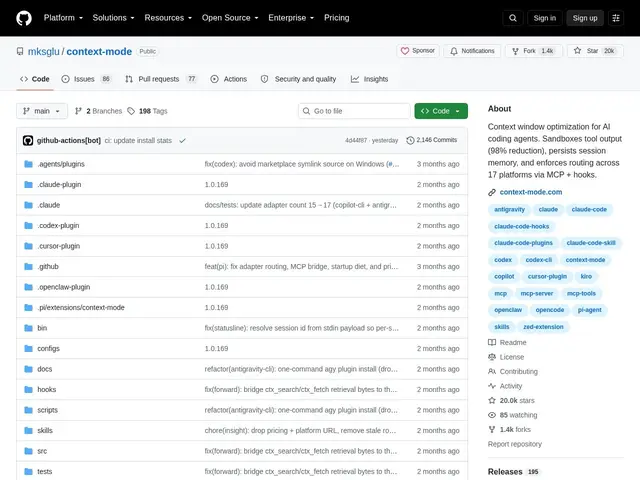
Description
When you chat with an AI coding assistant for a long time, it eventually "forgets" earlier parts of the conversation to make room for new information — and whatever got summarized away is gone for good. Context Mode tries to fix that: instead of dumping everything the assistant reads (file contents, command output, error logs) directly into the conversation, it keeps the raw data in a small local database and only hands the AI the specific bits it actually needs, indexed so it can search back through everything it has seen before.
Context Mode is a TypeScript-based MCP (Model Context Protocol) server that sandboxes tool output — a 315 KB Playwright snapshot, for instance, becomes roughly 5.4 KB handed to the model, a claimed ~98% reduction. Every file edit, git operation, task, error, and user decision is logged to a local SQLite database with FTS5 full-text search and BM25 ranking, so when a conversation compacts, the assistant can retrieve exactly what's relevant instead of losing context. It ships six sandbox tools (ctx_execute, ctx_batch_execute, ctx_index, ctx_search, ctx_fetch_and_index, ctx_execute_file) plus meta-tools for stats, health checks, and cleanup, and hooks into roughly 17 platforms including Claude Code, Cursor, VS Code/JetBrains Copilot, Gemini CLI, and GitHub Copilot CLI. It requires Node.js 22.5+ or Bun.
💬 Our review
The short version: Context Mode is a clever fix for the "my AI agent forgot everything after compaction" problem, but check the license before you assume it's the free open-source tool it looks like.
Technically it solves a real pain point well — persistent, searchable session memory via SQLite/FTS5 is a more durable approach than hoping a conversation summary captured the right details. The 98% output-reduction number is plausible for verbose tool output like browser snapshots or build logs. The catch: it's licensed under Elastic License v2 (ELv2), which is source-available, not truly open source — production/commercial use can carry restrictions that a permissive MIT or Apache project wouldn't. Support is also uneven across editors: Cursor lacks the SessionStart hook needed for clean post-compaction restore, and Zed/Antigravity have no hook support at all, falling back to manual instruction files. If you live in Claude Code or another fully-hooked platform, it's a strong pick; if your team is spread across Cursor and Zed, you'll get a degraded, partial version of the value proposition.
💰 Pricing
📊 Global score
🤖 AI-enriched data
Disponible gratuitement sur GitHub, npm et les marketplaces (Claude Code, Gemini CLI), mais sous licence ELv2 — pas open source au sens strict, usage commercial en production potentiellement restreint.
Pros
~98% de réduction sur les sorties d'outils verbeuses (ex. snapshots Playwright)
Mémoire de session persistante via SQLite + recherche FTS5/BM25
Compatible avec ~17 plateformes (Claude Code, Cursor, VS Code, Gemini CLI...)
6 outils sandbox + méta-outils de diagnostic intégrés
Cons
Licence Elastic v2 : source-available, pas open source, restrictions possibles en production commerciale
Cursor n'a pas le hook SessionStart → restauration post-compaction incomplète
Zed et Antigravity n'ont aucun support de hooks → contournement manuel nécessaire
Linux + Node < 22.5 non supporté (incompatibilités binaires natives)