Micdrop
An open-source developer toolkit for building the kind of real-time voice conversation you'd have with a phone-support AI — speech in, AI processing, voice out — directly in a web browser, without gluing together five separate services yourself.
🔗 Visit Micdrop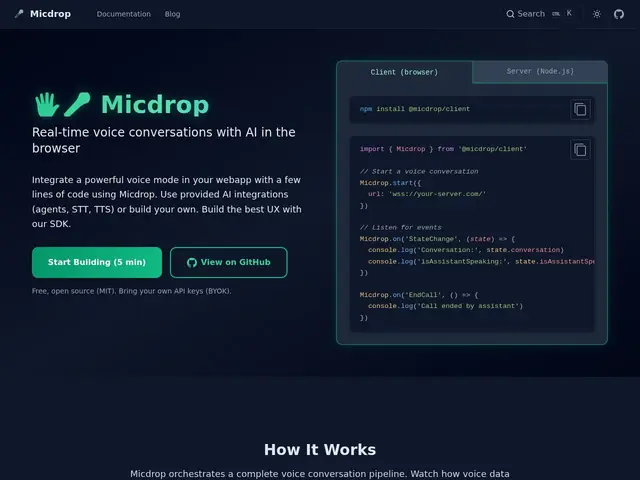
Description
Building a voice AI feature — the kind where you talk and an AI responds out loud in real time — normally means wiring together a speech-to-text service, an LLM, a text-to-speech service, and handling the streaming and interruption logic yourself. Micdrop packages that whole pipeline into one open-source toolkit so developers don't have to build the plumbing from scratch.
Micdrop is a TypeScript SDK, for both Node.js and the browser, that orchestrates real-time voice conversations with AI: capturing speech, transcribing it, sending it to an AI model, and streaming back synthesized speech with voice activity detection and support for real-time interruption. It's provider-agnostic — you can plug in OpenAI, Mistral, ElevenLabs, Cartesia, Gladia, or Gradium without being locked into one vendor, and it offers an EU-based sovereign deployment path for teams with GDPR requirements. It's free and open source (MIT license) on a bring-your-own-API-keys model, so you only pay whichever third-party AI services you actually choose to use.
💬 Our review
The short version: Micdrop is a solid pick if you want to build a voice AI feature without vendor lock-in and don't mind stitching your own provider choices together, but it's a developer toolkit, not a managed product — budget real integration time.
Compared to LiveKit or Vapi, which lean toward more managed, batteries-included voice-agent infrastructure, Micdrop's open-source, MIT-licensed, provider-agnostic approach trades convenience for control: no vendor lock-in, EU-sovereign deployment for GDPR-sensitive use cases, and zero licensing cost beyond the AI providers you choose. Pipecat occupies similar open-source territory, so the choice there often comes down to ecosystem fit and language preference (TypeScript vs. Python). The real cost here isn't the SDK — it's the engineering time to configure, test, and maintain multiple third-party API integrations yourself. Worth it for teams with in-house TypeScript expertise who want flexibility; a managed platform like Vapi will get a non-specialist team to a working demo faster.
💰 Pricing
📊 Global score
🤖 AI-enriched data
SDK gratuit et open source (MIT). Coût réel = les services IA tiers connectés (OpenAI, ElevenLabs, Mistral, Cartesia, Gladia, Gradium).
Pros
Agnostique au fournisseur, aucun verrouillage
Option de déploiement souverain en UE, conforme RGPD
Streaming basse latence avec détection d'activité vocale
Cons
Nécessite de gérer ses propres clés API tierces
Requiert une expertise TypeScript/Node.js
Aucun tarif groupé, coût dépendant des fournisseurs choisis