Tila
A visual workspace where you drag and connect different AI tools — for writing, images, video, voice — onto one canvas instead of juggling a dozen separate apps and subscriptions.
🔗 Visit Tila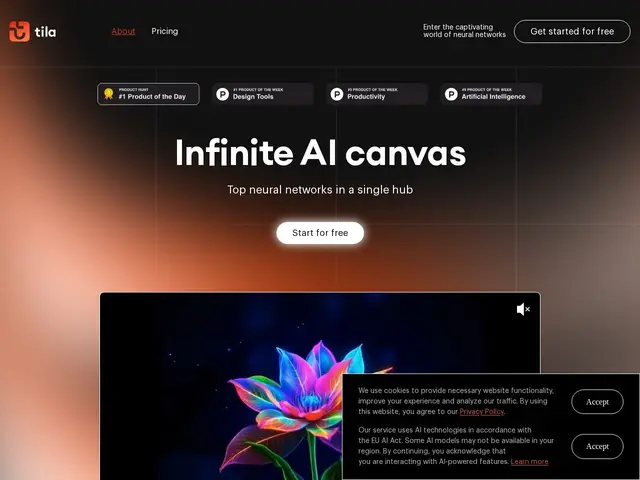
Description
Most people end up with a pile of separate AI subscriptions: one for chat, one for images, one for video, one for voice — each with its own tab, its own login, its own bill. Tila tries to fix that by putting all of it on a single infinite canvas: you drop in a piece of content (an idea, a photo, an audio clip) and connect it to different AI "agents" that can turn it into text, an image, a video, or a podcast-style summary, all without leaving the page.
Tila is a multi-agent AI platform built by Tovie Mobile around a visual, node-based canvas rather than a chat window. It gives you access to a wide roster of underlying models in one place — GPT-4o and 4.1, Claude 3.5/3.7 Sonnet and Haiku, Gemini 2 Flash and Pro, DALL-E 3, Flux 1.1 Pro, Ideogram v2, Recraft 3, Stable Diffusion, Luma Dream Machine, Kling 1.6, Minimax/Hailuo, ElevenLabs, and Whisper v3 — plus utility features like format conversion (turning audio into a mind map, or a website into a podcast script) and web search. The free plan includes 450 welcome credits plus 50 daily credits, with paid plans available but not listed publicly; heavy users can also draw on per-service API pricing for individual models. No information on funding, team size or founding date is published.
💬 Our review
The short version: Tila is genuinely useful as a single front-end to a dozen AI models if you don't want to manage separate subscriptions, but you're trading transparency and depth for convenience.
Tila's real selling point against a general chat interface (ChatGPT, Claude.ai) or a build-your-own tool like Zapier + individual APIs is the canvas itself — seeing your content, your agents, and your outputs as connected nodes makes multi-step, multi-format work easier to follow than a linear chat log. But bundling 18+ third-party models behind one subscription means you're paying a markup on top of what those models cost directly, and Tila doesn't publish its paid-tier pricing, so you can't easily compare that markup against, say, running the same models through OpenRouter or each provider's own API. The free tier (450 credits + 50/day) is enough to seriously test the workflow before paying anything, which is the right way to evaluate this one. Good fit for someone who wants one dashboard for scattered AI tasks; a worse fit for anyone with an existing setup optimized around one or two specific models, where switching adds cost without adding capability.
💰 Pricing
📊 Global score
🤖 AI-enriched data
Free : 450 crédits de bienvenue + 50 crédits/jour ; plans payants existants mais tarifs non publics ; tarification à l'usage possible par service (API)
Pros
Accès à 18+ modèles (texte, image, vidéo, audio) sous une seule interface
Interface canvas visuelle qui facilite les workflows multi-étapes
Palier gratuit généreux pour tester (450 crédits + 50/jour)
Cons
Tarifs des plans payants non publiés, comparaison difficile
Marge probable sur le coût réel des modèles sous-jacents
Aucune info sur l'entreprise, le financement ou l'équipe