Paraflow
An AI tool that helps turn a rough product idea into a structured spec and visual mockup, like having a product manager and a designer working the problem with you on one canvas.
🔗 Visit Paraflow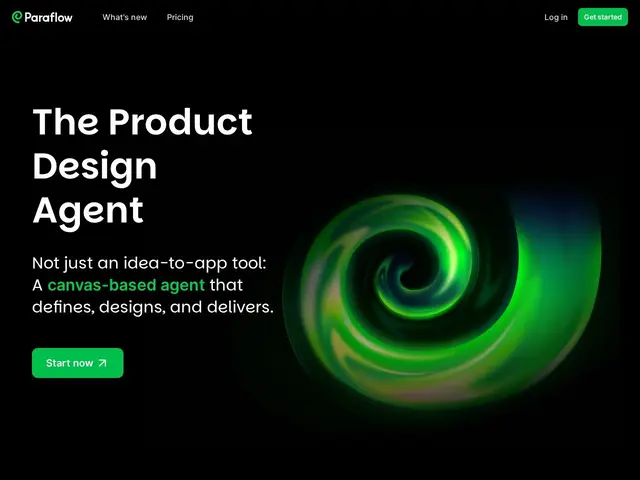
Description
Paraflow is a tool that helps you turn a rough product idea into a real, structured design brief without hiring a full team to hash it out first. Think of it like having a product manager and a designer sitting at the same virtual table with you: you describe what you want to build, and the tool helps turn that into a clear spec and visual mockups you can hand to developers, instead of you juggling sticky notes, spreadsheets, and a blank design file at the same time.
Paraflow runs on a canvas-based interface built around a three-phase workflow — define, design, deliver — where an AI agent helps structure requirements before moving into visual layout. It uses a credit-based pricing model rather than flat subscription tiers: a free plan gives 200 credits per day (capped at 500/month), while the Pro plan ($25/month, or $20/month billed annually) unlocks 2,500 credits per month. There's no published information on funding or team size, and the tool doesn't list specific third-party integrations on its public site — the 'two AI minds' framing (a product-manager agent and a designer agent) stays light on technical detail in the marketing, so hands-on testing during the free tier is the most reliable way to judge fit before paying.
💬 Our review
The short version: if you're a solo founder or small team that needs to go from "I have an idea" to a structured spec plus mockup fast, Paraflow's free tier is cheap enough to try, but the credit system and thin public information make it hard to fully judge before you're in.
Paraflow's pitch — an AI product manager and an AI designer collaborating with you on one canvas — puts it up against both AI design tools like Uizard or Galileo AI and full assistant-driven builders like v0 that skip straight to working code. Paraflow's angle is staying earlier in the funnel: it's about the spec and structure, not shipping a finished app. The credit system (200/day free, capped well below what a real project needs) functions more like an extended trial than a usable free plan, and at $25/month for 2,500 credits you're paying without much public evidence of output quality, team size, or how it holds up on a real multi-week product. Worth trying on the free tier for a single feature spec; not yet enough independent evidence here to recommend committing budget over an established design-plus-AI-assistant workflow.
💰 Pricing
📊 Global score
🤖 AI-enriched data
Free : 200 crédits/jour (plafond 500/mois) ; Pro : 25 $/mois (20 $/mois en facturation annuelle) pour 2 500 crédits/mois
Pros
Combine définition du besoin (spec) et design visuel dans un seul outil
Workflow structuré en 3 phases (define/design/deliver)
Palier gratuit accessible pour tester sans carte bancaire
Cons
Système de crédits opaque, plus proche d'un essai prolongé que d'un vrai plan gratuit
Aucune info publique sur l'équipe, le financement ou les intégrations tierces
Pas de comparatif direct avec la concurrence sur le site officiel