Noirdoc
A gateway that sits between your app and AI models like GPT or Claude, strips out names, emails and other personal details before the data leaves Europe, and charges you only what the model provider charges — no markup.
🔗 Visit Noirdoc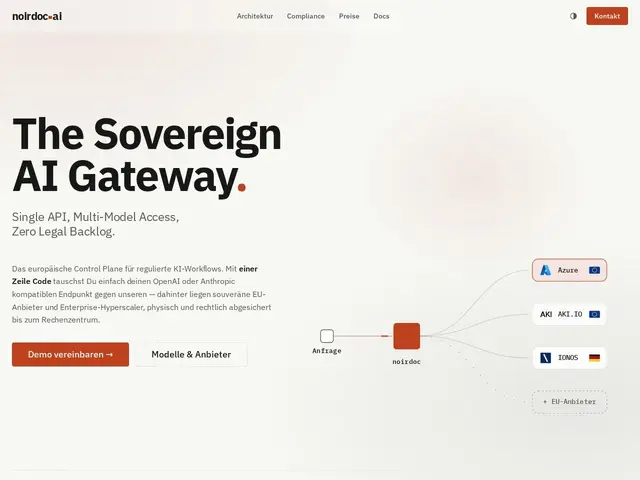
Description
If your company handles client data and operates under European privacy law, sending that data straight to a US-based AI provider can be a compliance headache even when the AI itself is great. Noirdoc is built to sit in between: it's a drop-in replacement for the OpenAI-style API that routes your requests to 21+ underlying models (OpenAI, Anthropic, Azure, and others) through a control plane based in Germany, with an optional step that automatically masks personal information — names, emails, phone numbers, IBANs — before anything reaches the model, and can reverse that masking afterward if you need the real data back.
Noirdoc is built by Nextaim GmbH, based in Munich, positioned around European AI sovereignty and compliance with German law (including § 203 StGB, which covers professional confidentiality). It's OpenAI SDK-compatible, so switching an existing integration typically means changing a base URL rather than rewriting code, and it works with common frameworks like LangChain and LlamaIndex. It also ships a dedicated plugin for masking data before Claude Code reads it, which is relevant for developers who don't want client PII sitting in an AI coding assistant's context window. Pricing has no platform markup — you pay the underlying provider's list price per token (roughly €0.01 to €4.83 per million input tokens depending on the model), with no setup fees or minimum commitments, and you can bring your own provider API keys.
💬 Our review
The short version: if you're a European company that wants to use frontier AI models without a data-residency or PII headache, Noirdoc's zero-markup, Germany-based gateway is a smart, low-risk way to add a compliance layer without rewriting your integration.
Noirdoc's real value against just calling OpenAI or Anthropic directly is the compliance layer — PII masking plus a German control plane — for organizations that legally need European data handling, which is a genuine gap most US-first AI providers don't fill on their own. Compared to building this yourself (a self-hosted proxy plus a PII-scrubbing library), Noirdoc saves the engineering time of stitching those pieces together and keeps them maintained. The zero-markup pricing is a strong, verifiable claim since you're paying published provider rates rather than a black-box subscription. The tradeoff is scope: this solves data residency and PII exposure, not model quality or feature parity — you still get exactly what OpenAI or Anthropic ship, just routed and filtered. For regulated European businesses (legal, healthcare, finance) or any team nervous about client data in Claude Code's context, it's worth adopting; for a hobbyist project with no compliance requirement, it adds a layer of complexity you probably don't need.
💰 Pricing
📊 Global score
🤖 AI-enriched data
Aucune marge de plateforme : prix payé = tarif fournisseur direct, environ 0,01 à 4,83 €/million de tokens en entrée selon le modèle ; pas de frais fixes ni de minimum
Pros
Masquage automatique et réversible des données personnelles avant envoi au modèle
Aucune marge sur les tokens, prix fournisseur direct
Compatible SDK OpenAI, migration simple ; plugin dédié pour Claude Code
Cons
N'améliore pas la qualité des modèles, seulement le routage et la conformité
Complexité supplémentaire inutile pour un usage non régulé
Peu d'informations publiques sur la taille de l'équipe ou le financement