Rakazo
Think of the repetitive parts of your job — triaging your inbox, doing first-pass candidate screening, chasing sales leads — as tasks you'd love to hand to a reliable junior teammate who never gets bo
🔗 Visit Rakazo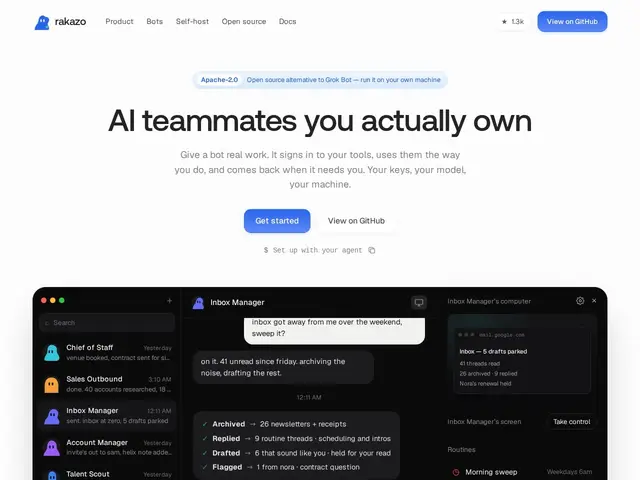
Description
Think of the repetitive parts of your job — triaging your inbox, doing first-pass candidate screening, chasing sales leads — as tasks you'd love to hand to a reliable junior teammate who never gets bored. Rakazo lets you build exactly that: a self-hosted AI "teammate" with its own memory, its own recurring routines, and its own conversation history, that you run on hardware you control instead of trusting to a SaaS vendor.
Rakazo is open source (Apache 2.0) and runs entirely on your own machine or server, with each bot sandboxed in its own Docker container. You choose which AI model powers each bot — Claude, GPT, Grok, or a local model — and bots can be reached from a web app, an Electron desktop client, or a mobile app, with voice mode included. It ships with eight pre-built templates for common repetitive workflows (sales follow-up, inbox triage, recruiting screens, finance tasks) and lets a bot create sub-bots to delegate parts of a task, with full conversation and audit history kept locally.
💬 Our review
The short version: Rakazo is a compelling pick if you specifically want AI automation without your data or conversations ever leaving your own infrastructure — but be ready to run Docker yourself.
Against no-code automation tools like Zapier or Make.com, Rakazo's angle isn't visual workflow triggers — it's persistent, memory-carrying AI teammates that hold context across sessions the way a human colleague would, which those tools don't really attempt. Against hosted "AI employee" products, the differentiator is total data ownership: nothing routes through Rakazo's own servers, since there currently isn't a cloud offering at all — self-hosting is the only option today. That's the trade-off worth weighing: setup requires comfort with Docker and supplying your own LLM API keys, and documentation beyond the eight shipped templates is still thin for a young project. For a privacy-conscious team or a technically capable founder who wants automation without sending data to another SaaS, Rakazo is worth the setup time; if you just want quick workflow automation with a UI and don't care where the data lives, Zapier or Make will get you there faster.
💰 Pricing
📊 Global score
🤖 AI-enriched data
Apache 2.0, gratuit, auto-hébergé. L'utilisateur fournit ses propres clés API de modèles IA. Version cloud annoncée mais pas encore disponible.
Pros
Propriété totale des données et de la vie privée
Pas de verrouillage fournisseur ni de tarification par siège
Exécution sandboxée dans des conteneurs Docker
Support multi-LLM avec choix de modèle par bot
Modèles préconstruits pour workflows courants
Cons
Auto-hébergement nécessite une configuration Docker technique
Offre cloud encore indisponible
Documentation limitée au-delà des modèles fournis
Dépend des clés API LLM de l'utilisateur