Paperclip
Once you're running more than one or two AI agents to get work done, a new problem shows up that has nothing to do with any single agent's intelligence: who's in charge, who approved what, and how muc
🔗 Visit Paperclip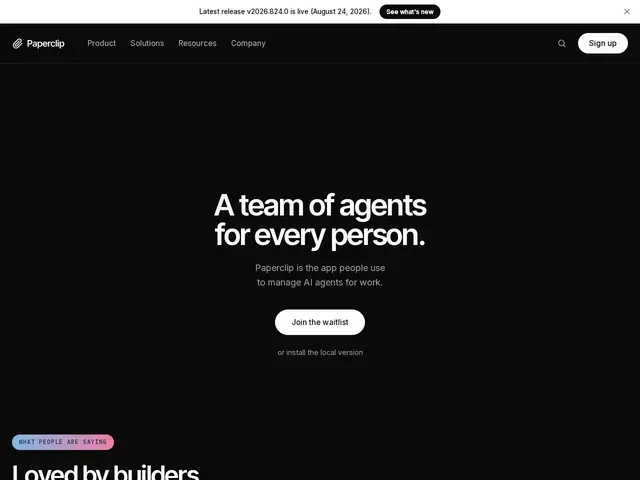
Description
Once you're running more than one or two AI agents to get work done, a new problem shows up that has nothing to do with any single agent's intelligence: who's in charge, who approved what, and how much did it all cost? Paperclip is built to answer exactly that — it's an open-source "control plane" that sits above your AI agents and gives them an org chart, a budget, and a paper trail, the same structure a human team would have.
With Paperclip, you hire AI agents into defined roles with managers and specialties (mixing in real human teammates alongside them if you want), assign them goals, and route work through that org chart instead of a single unstructured chat thread. It's model-agnostic, so agents from different providers can sit in the same org, and it enforces governance you'd expect from managing a real team: agents can't hire other agents without your sign-off, hard budget and spending caps prevent runaway costs, and every action is recorded in an immutable audit log. It's open source under the MIT license and self-hosted.
💬 Our review
The short version: Paperclip is aimed less at people who want smarter agents and more at people who already have several agents and have lost track of what they're doing and what they're costing.
The clearest way to place it is one layer up from agent-building frameworks like LangGraph: LangGraph is how you construct an individual AI "employee," while Paperclip is closer to the company structure that employee works inside — org chart, approval gates, budgets, and audit trails on top of whatever agents you've already built or bought. That makes it complementary rather than competing with most agent frameworks, and its governance features (hard spending caps, agents needing approval to hire sub-agents, immutable logs) are genuinely more thorough than what generic orchestration tools offer. The rough edges are honest ones for an early open-source project: pricing for any future cloud offering isn't published (it's currently on a waitlist), setup documentation is thinner than the concept deserves, and the learning curve is real if you're not already comfortable with agent orchestration concepts. For a team running multiple AI agents that needs cost control and accountability more than raw capability, Paperclip fills a real gap; a solo user running one agent has no use for it yet.
💰 Pricing
📊 Global score
🤖 AI-enriched data
Licence MIT, auto-hébergé, gratuit. Fonctionnalités cloud en liste d'attente, tarifs non communiqués.
Pros
Orchestration agnostique au modèle/fournisseur
Contrôles de coûts avec plafonds stricts
Gouvernance complète (validations, pause, arrêt)
Traces d'audit immuables pour la conformité
Open source, extensible par plugins
Cons
Aucune transparence tarifaire pour l'offre cloud
Documentation de mise en route encore limitée
Pas de comparatif face aux outils d'automatisation existants
Courbe d'apprentissage pour non-initiés à l'orchestration d'agents