NanoClaw
Most people's first AI assistant lives inside a chat app window and forgets everything the moment they close the tab. NanoClaw is a personal AI assistant that instead lives on your own computer and ta
🔗 Visit NanoClaw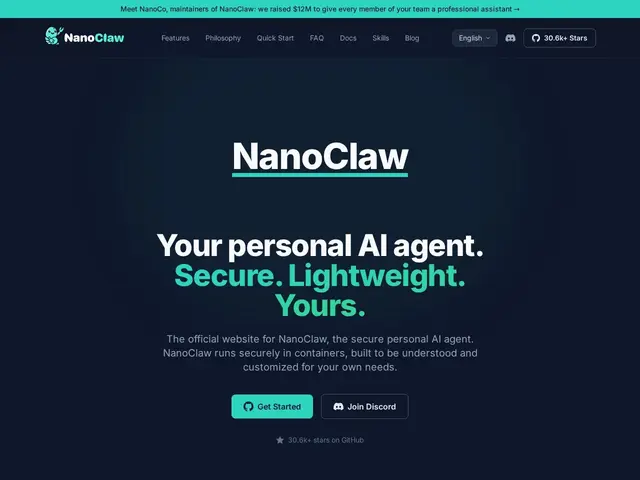
Description
Most people's first AI assistant lives inside a chat app window and forgets everything the moment they close the tab. NanoClaw is a personal AI assistant that instead lives on your own computer and talks to you through the messaging apps you already have open — WhatsApp, Telegram, Discord, Slack, or just your terminal — and can actually do things: search the web, read a file you send it, run code, and remind you about something tomorrow at 9am, all without any setup beyond installing it.
Built on Anthropic's open-source Claude Agent SDK and released under the MIT license, NanoClaw runs each conversation in its own locked-down Linux container, so the assistant can write and execute real code or open files you share with it without having free rein over your machine. It connects to 15+ messaging channels out of the box, keeps scheduled and recurring tasks alive across restarts, and — notably for an AI agent project — keeps its own codebase small (roughly 200 TypeScript files versus thousands in comparable frameworks), which makes it realistic for a technical user to actually read and audit.
💬 Our review
The short version: NanoClaw is the pick if you want a genuinely personal, self-hosted AI assistant you can audit yourself, reachable from apps you already use daily — but it's built for developers, not for someone who wants a no-setup consumer chatbot.
Compared to a general orchestration framework like LangGraph, NanoClaw isn't trying to be a building-block library for developers to assemble bespoke agent pipelines — it's a ready-to-run personal assistant you install and start chatting with immediately, closer in spirit to Dify's out-of-the-box feel but self-hosted rather than cloud-based. Its main claim to fame is auditability: a codebase small enough to actually read, container-level isolation per session, and credential isolation through its "Agent Vault" — real security properties, not just marketing language, backed by 30.6k GitHub stars and $12M in funding that suggests it isn't a weekend project. The honest limitation is the audience: you need Docker, some comfort with a terminal, and ideally your own Claude API key (though local Ollama models work too), so it's not aimed at non-technical users. For a developer who wants a real personal AI agent under their own control, NanoClaw is one of the stronger open options available; for a total non-technical user, a consumer chat app remains the easier starting point.
💰 Pricing
📊 Global score
🤖 AI-enriched data
Licence MIT, gratuit. Coûts liés au fournisseur IA choisi (clé API Claude, ou modèles locaux Ollama gratuits).
Pros
Codebase minimal et auditable (~200 fichiers)
Isolation par conteneur au niveau OS
Isolation des identifiants via Agent Vault
Routage multi-canal (15+ plateformes de messagerie)
Architecture modulaire par skills
Cons
Nécessite Docker
Connaissances terminal/code nécessaires pour personnaliser
Pas de support Kubernetes (Docker uniquement)
Courbe d'apprentissage pour les non-développeurs