Aident Loadout
An AI coding assistant that can only talk to you in a chat window is limited — the real value shows up when it can also send the email, update the spreadsheet, or create the Linear ticket itself. Aide
🔗 Visit Aident Loadout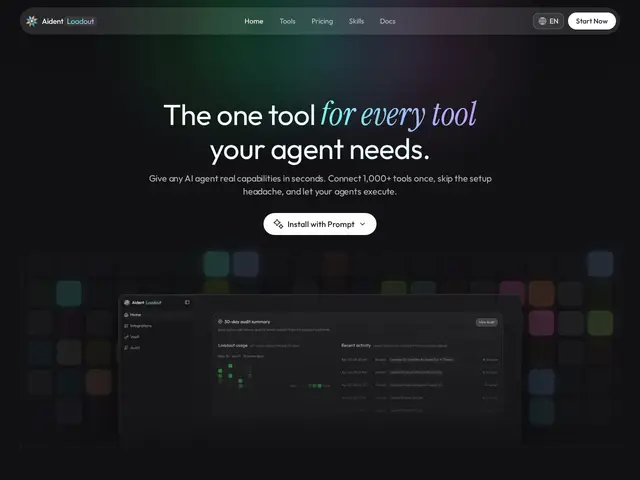
Description
An AI coding assistant that can only talk to you in a chat window is limited — the real value shows up when it can also send the email, update the spreadsheet, or create the Linear ticket itself. Aident Loadout is a connector layer that gives AI agents like Claude Code, Cursor, or ChatGPT access to over 1,000 real apps and tools — Gmail, Slack, Linear, Notion, and more — so they can actually take action in the software you already use, instead of just describing what you should click next.
Loadout works through a credential vault: you connect each app once via OAuth or API key, and any supported agent can then reuse that connection to execute one of 27,000+ available actions, with every action recorded in an audit log so you can see exactly what ran and whether it succeeded. It supports a wide range of MCP-compatible clients (Claude Code, Cursor, OpenCode, ChatGPT, Claude Desktop, and more), and bundles discounted access to a few premium services like Firecrawl and Fal alongside the standard integrations.
💬 Our review
The short version: Loadout is worth it once you're actually running AI agents that need to touch several different apps — it saves you from wiring up 1,000 separate integrations or API keys yourself.
The natural comparison is Composio, which occupies a similar niche of giving AI agents tool access across many apps, and to a lesser extent Zapier or n8n, which connect apps together but aren't built agent-first. Loadout's argument is breadth (1,000+ apps, 27,000+ actions) plus a security model — OAuth and API keys live in a vault, and agents receive action results rather than raw credentials, with every action auditable. That's a meaningfully more agent-appropriate security posture than handing an LLM your raw API keys directly. The rough edge is transparency: exact pricing tiers (Pro, Team, Credit Boosts) are referenced but not laid out in clear public detail, so expect to poke around or sign up for a trial to understand real costs before committing budget. For anyone running coding agents or automations that need to reach into Gmail, Slack, Notion, or similar tools regularly, Loadout removes a real chunk of integration plumbing; a user with just one or two simple integration needs may find direct API access or Zapier simpler.
💰 Pricing
📊 Global score
🤖 AI-enriched data
Palier de démarrage à l'usage, plans Pro et Team avec limites plus élevées, Credit Boosts ponctuels. Essai disponible.
Pros
Connexion en un clic réutilisable entre plusieurs agents
Trace d'audit complète, modèle de sécurité sans fuite
Compatible large éventail de clients MCP
Accès à des outils premium à tarif réduit
Pas de gestion séparée des identifiants par outil
Cons
Limité à l'écosystème d'agents supportés
Détails tarifaires peu clairs sur le site public
Dépendance à l'infrastructure OAuth/identifiants maintenue par Aident