GoRules
A lot of business logic — "approve this loan if income is above X and credit score above Y", "flag this insurance claim for manual review if..." — ends up buried inside application code, which means c
🔗 Visit GoRules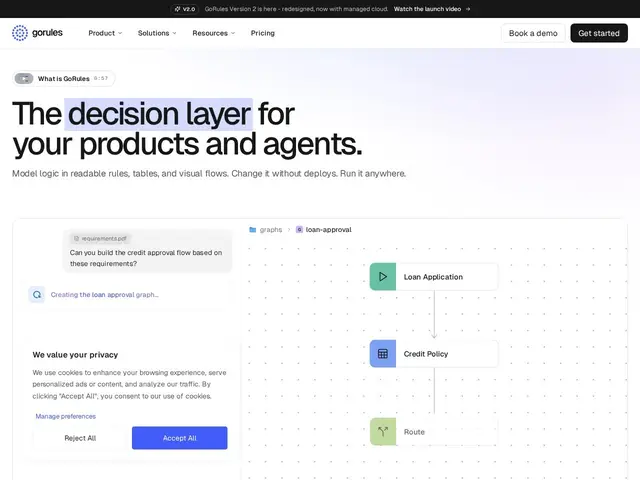
Description
A lot of business logic — "approve this loan if income is above X and credit score above Y", "flag this insurance claim for manual review if..." — ends up buried inside application code, which means changing a single number requires a developer, a code review, and a deployment. GoRules exists to pull that decision logic out of the codebase and into a visual, readable format that non-developers can understand and, within limits, edit themselves — without redeploying the app.
GoRules is an open-source business rules engine (the "Zen Engine") that lets you define decisions as readable rules, decision tables, or visual flow diagrams, then run them from nine language bindings (JavaScript, Python, Go, Rust, Java, Kotlin, C#, Swift) with sub-millisecond execution. It's used in regulated, decision-heavy industries — lending and fraud detection in financial services, underwriting and claims in insurance, triage rules in healthcare — where an audit trail and testable, version-controlled rules matter as much as raw speed. Fortune 100 companies pull it 700,000+ times a month across npm, PyPI, and crates.io.
💬 Our review
The short version: GoRules is worth using if your team keeps rewriting decision logic in code and wishes non-developers could safely tweak the thresholds — it's free at the core and genuinely fast.
Against heavyweight incumbents like Drools or Camunda, GoRules' pitch is approachability: readable rules and decision tables instead of a full BPMN engine to learn, with bindings across nine languages so you're not locked into a JVM stack. That makes it a good fit for teams that want "rules as data" without buying into a full business process management suite. The trade-off is that GoRules' visual flow editor is simpler than what Camunda or full BPM platforms offer, so very intricate, multi-department decision trees may still need real engineering discipline to keep readable. Pricing is also somewhat opaque — the engine itself is free and open source, but the hosted cloud SaaS pricing isn't clearly published, so budget-conscious teams should expect to reach out before committing. For a startup or mid-size company automating lending, underwriting, or eligibility rules, the open-source core alone is usually enough to be worth adopting.
💰 Pricing
📊 Global score
🤖 AI-enriched data
Moteur open source gratuit. Offre cloud SaaS disponible mais tarifs non publiés clairement sur le site.
Pros
Syntaxe de règles lisible, peu de code requis
Exécution sub-milliseconde
Tests, scénarios et contrôle de version intégrés
Traces d'audit et conformité (SOC 2 Type II)
9 langages supportés (JS, Python, Go, Rust, Java, Kotlin, C#, Swift)
Cons
Courbe d'apprentissage pour la logique très complexe
Éditeur visuel plus limité que certains concurrents low-code
Tarifs du SaaS cloud peu visibles publiquement