BugPin
"It's broken, fix it" is the least useful bug report a developer can receive — no screenshot, no browser info, no idea what the user actually clicked. BugPin is a small widget you drop into your websi
🔗 Visit BugPin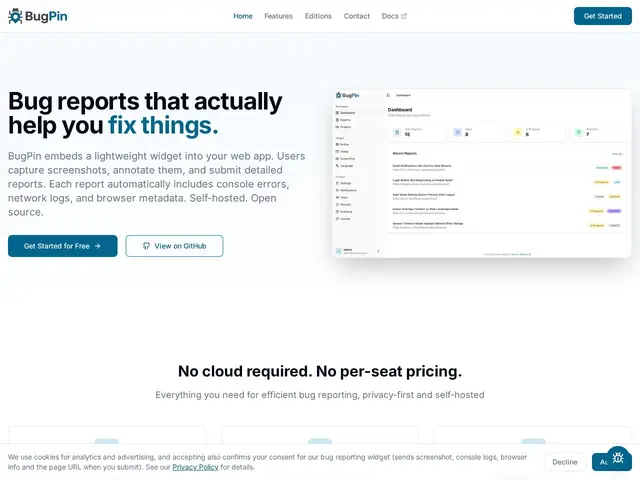
Description
"It's broken, fix it" is the least useful bug report a developer can receive — no screenshot, no browser info, no idea what the user actually clicked. BugPin is a small widget you drop into your website that turns any bug report into something a developer can actually act on: the reporter clicks the broken element, draws on a screenshot to highlight it, and BugPin automatically attaches the page URL, browser console errors, and network request logs — all without the reporter typing a single technical detail.
BugPin is self-hosted and open source, installable with a single script tag, and stores everything on your own servers via SQLite and Docker rather than a third-party SaaS. It includes drawing and annotation tools (pen, rectangle, circle, arrow, text, blur for sensitive info), works offline with reports queued until the connection returns, supports 8 languages, and integrates with GitHub for turning reports directly into issues. The Community Edition is free forever; an Enterprise tier adds SSO, webhooks, and white-label branding for larger teams.
💬 Our review
The short version: if your team currently gets bug reports as vague Slack messages, BugPin's free Community Edition alone will noticeably improve report quality — and you keep the data on your own servers.
Against Marker.io, BugHerd, or Usersnap — the established SaaS players in this space — BugPin's pitch is straightforward: the same core capture-and-annotate workflow, but self-hosted and free at the core instead of a recurring per-seat SaaS bill. That matters most for teams with privacy or compliance requirements that make sending screenshots and console logs to a third party's cloud a problem. The honest gap is maturity: BugPin is a smaller, younger project, so its enterprise-scale features (granular permissions, large-team collaboration workflows) are less fleshed out than what Usersnap or Marker.io have built over years, and its community is correspondingly smaller if you need fast support. For a small-to-mid dev team or a privacy-conscious SaaS company that wants better bug reports without a new line item in the SaaS budget, BugPin's free tier is worth adopting; a larger team that needs mature multi-team permission structures today may still be better served by an established paid tool.
💰 Pricing
📊 Global score
🤖 AI-enriched data
Édition Communautaire gratuite à vie avec toutes les fonctionnalités clés. Palier Entreprise avec SSO, webhooks et marque blanche.
Pros
Auto-hébergé et axé vie privée
Léger (moins de 150 Ko compressé)
Outils d'annotation intégrés (stylo, formes, flou)
Fonctionne hors ligne avec mise en cache locale
Intégration simple via une seule balise script
Cons
Informations limitées sur la scalabilité entreprise
Fonctions de collaboration/permissions d'équipe encore sommaires
Différenciation concurrentielle peu mise en avant
Communauté plus restreinte que les alternatives établies