Supernova
Syncs Stripe, HubSpot, Postgres, and 40+ other business tools into one encrypted data lake you can query directly from Claude or Codex, without waiting on engineers or building a BI stack.
🔗 Visit Supernova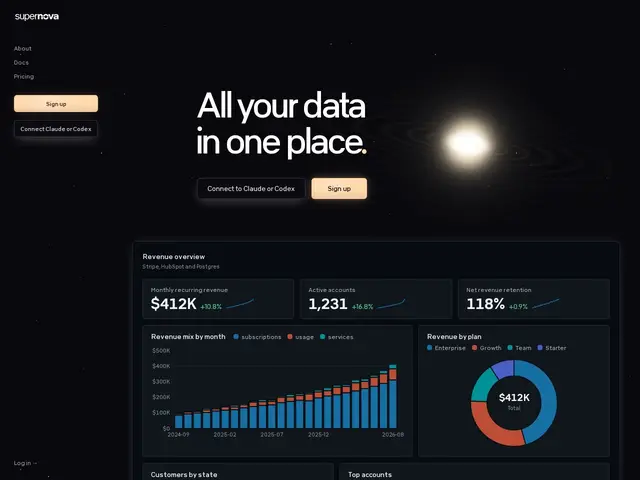
Description
Getting a straight answer to "how's revenue trending against last quarter" often means pinging an engineer, waiting for a dashboard to be built, or exporting spreadsheets from three different tools by hand. Supernova skips that: it connects your company's live data sources — Stripe, HubSpot, Postgres, Salesforce, Shopify, Google Analytics, and dozens more — into one place, and lets anyone ask questions about it directly inside the AI tools they already use, like Claude or Codex.
Under the hood, Supernova syncs data into an encrypted Iceberg-format data lake with table-level encryption, using a schema-aware query layer it calls TypeSQL. Setup is meant to be fast: add mcp.supernova.ai/mcp to Claude or Codex and your data becomes queryable in about a minute, with real-time sync for Postgres and MongoDB. Pricing is fully usage-based — $0.15/GB-hour for compute, $0.05/GB-month for storage, $0.40-$5 per million operations, plus a 1.5x pass-through on AI tokens — with no flat per-seat fee, which the company frames as dramatically cheaper than a traditional data warehouse for most startups.
💬 Our review
The short version: if your team already lives in Claude or Codex and wants to ask real business questions without waiting for a data team, Supernova is a clever, low-friction way to get there — the usage-based pricing keeps it cheap at small scale but requires some care once volume grows.
Compared to building a traditional BI stack with a warehouse like Snowflake or BigQuery plus a visualization layer like Looker or Metabase, Supernova's advantage is skipping most of that setup — you connect sources and query in natural language through an AI assistant you already use, rather than learning a new dashboarding tool. The tradeoff is usage-based pricing with no flat cap: predictable for light usage, but worth watching closely as data volume and query frequency scale, since costs compound across compute, storage, operations, and AI token pass-through simultaneously. For an early-stage company without a dedicated data team, that's still likely far cheaper and faster than hiring for or building a warehouse from scratch; for a company already running a mature BI stack, switching costs may not be worth it unless the Claude/Codex-native querying is specifically what you're missing.
💰 Pricing
📊 Global score
🤖 AI-enriched data
0,15$/Go-heure de calcul, 0,05$/Go/mois de stockage, 0,40$ à 5$ par million d'opérations, jetons IA facturés à 1,5x le prix fournisseur. Aucun forfait fixe par utilisateur.
Pros
Connexion à 40+ sources (Stripe, HubSpot, Postgres, Salesforce...)
Interrogation en langage naturel directement depuis Claude/Codex
Synchronisation temps réel pour Postgres et MongoDB
Chiffrement au niveau table, lac de données au format Iceberg
Configuration rapide (environ une minute via MCP)
Cons
Facturation 100% à l'usage, sans forfait prévisible
Coûts qui peuvent s'accumuler vite à fort volume (calcul + stockage + opérations + IA)
Nécessite déjà d'utiliser Claude ou Codex pour tirer pleinement parti de l'outil
Pas de couche de visualisation dédiée façon BI classique