fx
Vercel's tiny, open-source coding agent — an 8 MB native binary written in Zig, built to start instantly and embed inside other tools rather than run as a heavyweight chat app.
🔗 Visit fx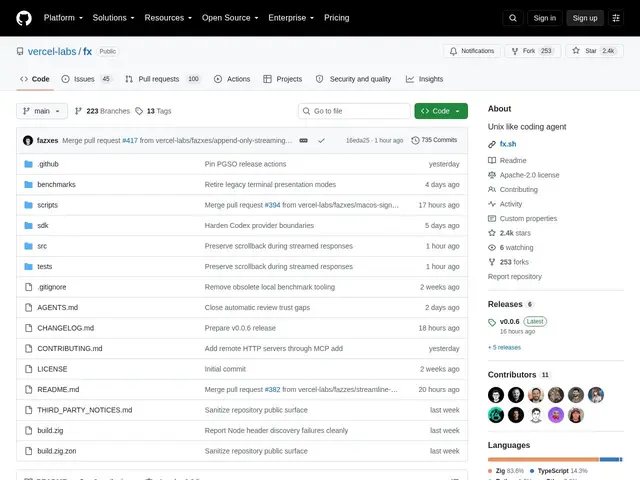
Description
Most AI coding agents today are built like chat apps: a runtime to install, gigabytes of dependencies, and a few seconds of startup lag before you can type your first prompt. fx takes the opposite approach — it's a single native binary under 8 MB, written in the systems language Zig specifically so it can start in microseconds and run with almost no memory overhead, more like a Unix command-line tool than a chat interface.
fx started as an internal tool at Vercel before being open-sourced on August 17, 2026 under the Apache-2.0 license. It's model-agnostic (works with multiple AI providers, local or cloud), supports session resumption, and extends through skills, plugins, and MCP tools rather than a fixed feature set — plus WebAssembly support for embedding it inside other software. The tradeoff for that minimalism: the project is explicitly marked experimental, with the maintainers flagging that its autonomous execution needs careful permission management, and it currently favors a narrower set of auth/provider integrations than more mature CLI agents.
💬 Our review
The short version: if you're a developer who wants a coding agent that behaves like a lightweight CLI tool you can script or embed — not a heavyweight chat app — fx is a genuinely interesting free, open-source option worth trying, but it's early and experimental.
Compared to Claude Code, Cursor's CLI, or OpenAI's Codex CLI, fx's whole design argument is size and speed: at under 8 MB with microsecond cold starts, it's built to be embedded inside CI pipelines, other tools, or resource-constrained environments where a full agent runtime would be overkill. It sacrifices some of the polish and provider breadth those more mature tools offer in exchange for that minimalism. Since it's free and open source with no pricing to weigh, the real cost is risk tolerance: the maintainers themselves flag it as experimental, so it's a better fit for developers comfortable running early-stage tooling and reviewing agent actions carefully than for teams wanting a production-hardened daily driver today.
💰 Pricing
📊 Global score
🤖 AI-enriched data
Gratuit, licence Apache-2.0. Aucun coût, binaire de moins de 8 Mo.
Pros
Binaire natif ultra-léger (moins de 8 Mo), démarrage en microsecondes
Gratuit et open source (Apache-2.0)
Agnostique au modèle : fonctionne avec plusieurs fournisseurs IA, local ou cloud
Extensible via skills, plugins et MCP
Support WebAssembly pour intégration dans d'autres outils
Cons
Marqué explicitement comme expérimental par ses créateurs
Gestion des permissions à surveiller de près (exécution autonome)
Intégrations fournisseurs/authentification plus limitées que des outils plus matures
Peu de recul en production, projet tout juste open-sourcé