Nushell
A modern command-line shell, written in Rust, that treats the output of every command as structured data — tables and records — instead of plain text.
🔗 Visit Nushell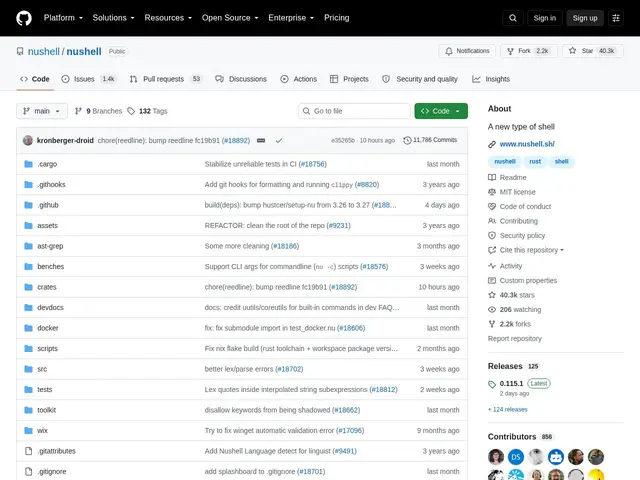
Description
Traditional shells like bash pass text between commands, which means every tool has to invent its own way of parsing that text back into something useful — a constant source of fragile scripts. Nushell takes a different approach: every command's output is structured data from the start, so listing files, reading a CSV, or querying an API all produce the same kind of table you can filter, sort, and reshape with consistent, predictable commands.
Nushell provides typed, structured pipelines instead of raw text streams, native parsing of JSON/TOML/CSV/YAML, cross-platform consistency across Windows, macOS and Linux, autocomplete, and a plugin architecture for extending it further. It's written in Rust for performance and safety, free and open source under the MIT license, with 40.3k GitHub stars and a very active development pace.
💬 Our review
The short version: if you've ever chained grep, awk, and cut together to parse a shell command's output, nushell removes that entirely — every command already returns structured data you can query directly.
Against bash or zsh, the tradeoff is real: nushell isn't POSIX-compatible, so your existing shell scripts won't just run, and there's a genuine learning curve adjusting to structured pipelines instead of text streams. Against PowerShell, which pioneered the same structured-object idea, nushell is lighter-weight, fully cross-platform by design, and open source. It's still evolving — the project describes itself as reaching MVP maturity with some commands not fully stabilized — but with 40k+ stars and a fast release cadence, it's clearly past the experimental stage and used as a daily driver by a large community. Worth trying as your interactive shell even if you keep bash for portable scripts.
💰 Pricing
📊 Global score
🤖 AI-enriched data
Projet open source (licence MIT), aucune offre payante
Pros
Pipelines de données structurées (tables, records) plutôt que du texte brut
Parsing natif JSON/TOML/CSV/YAML
Cohérence multiplateforme (Windows, macOS, Linux)
Écrit en Rust, performant et sûr
40 300+ étoiles, développement très actif
Cons
Courbe d'apprentissage pour les habitués de bash/zsh
Pas compatible POSIX, scripts bash existants à réécrire
Certaines commandes encore instables (maturité MVP)