Second Brain
A free, self-hosted memory that you own — store something once and Claude, ChatGPT and Cursor can all recall it later, instead of re-explaining your context to each tool separately.
🔗 Visit Second Brain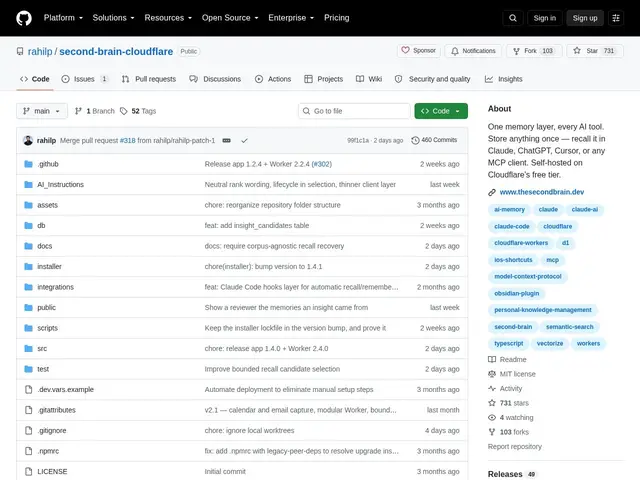
Description
If you use several different AI assistants — say Claude for writing, Cursor for coding, ChatGPT for research — none of them remember what you told the others. You end up re-explaining the same project background, decisions, and preferences over and over. Second Brain fixes that by giving you one shared memory that any of those tools can read from and write to, running entirely in your own Cloudflare account rather than inside any single AI vendor's walled garden.
Second Brain is an open-source (MIT-licensed) memory layer you deploy yourself for free on Cloudflare's free tier, exposing memory tools (remember, recall, append, update, forget, list_recent) over MCP so any compatible client — Claude, ChatGPT, Cursor and others — can use it. It finds memories by meaning through semantic vector search rather than exact keyword match, organizes related memories into a knowledge graph (in v2) so recall can follow relationships between projects, decisions and people, and integrates with Notion, Google/Outlook calendars, Gmail, Obsidian, a browser extension and iOS shortcuts. It ships with a dashboard for browsing memories and a desktop app for Mac and Windows. On GitHub it has around 731 stars, 103 forks and 460+ commits, with a recent push (2026-08-23) showing active development, and it reached #3 Product of the Day on Product Hunt.
💬 Our review
The short version: if you're tired of re-explaining the same project context to Claude, ChatGPT and Cursor separately, Second Brain gives every one of them access to the same memory, and it costs nothing to run since it lives in your own free-tier Cloudflare account.
The real differentiator against a single vendor's built-in memory feature (like ChatGPT's memory or Claude's project context) is portability and ownership: your memory isn't locked inside one AI app, it's a self-hosted layer any MCP-compatible client can plug into, which matters if you regularly switch between tools or don't want a vendor holding your accumulated context hostage. Compared to other open memory projects like mem0 or Letta/MemGPT, Second Brain's pitch is broader integration surface (calendars, Gmail, Notion, Obsidian, browser, iOS) rather than being purely a memory API for developers to embed. The tradeoffs are real for a young, fast-moving open-source project: setup requires a Cloudflare account, the Windows desktop app currently lacks code signing (expect SmartScreen warnings), and some integrations (OAuth in Cursor, lazy-loaded MCP schemas) have known rough edges. Worth setting up if you're a multi-tool AI power user who wants portable, self-owned memory and doesn't mind some early-project friction; less appealing if you just want a zero-setup memory feature built into a single assistant you already use.
💰 Pricing
📊 Global score
🤖 AI-enriched data
Open source (licence MIT), auto-hébergé gratuitement sur le tier gratuit Cloudflare, aucun abonnement requis
Pros
Mémoire partagée entre plusieurs assistants IA (Claude, ChatGPT, Cursor) via MCP
Auto-hébergé gratuitement sur le tier gratuit Cloudflare — pas de verrouillage fournisseur
Recherche sémantique par le sens, pas seulement par mot-clé
Intégrations larges : Notion, calendriers Google/Outlook, Gmail, Obsidian, extension navigateur, raccourcis iOS
Communauté GitHub active (731 étoiles, développement récent)
Cons
Nécessite la création d'un compte Cloudflare pour l'auto-hébergement
App desktop Windows non signée (avertissements SmartScreen)
Quelques accrocs connus (OAuth dans Cursor, chargement paresseux des schémas MCP)
Projet jeune, encore en évolution rapide