Leptos-Native
An open-source Rust library that lets you build native desktop and mobile apps using the same reactive, component-based style as the Leptos web framework.
🔗 Visit Leptos-Native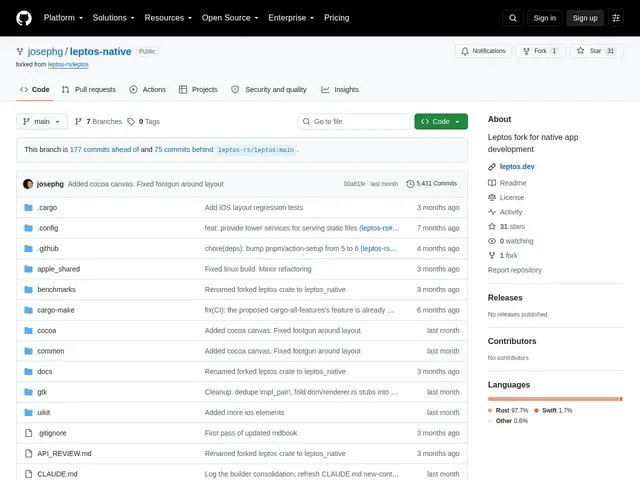
Description
Web developers who already write reactive components — the kind of code where the UI just updates itself when data changes — often have to learn a completely different toolkit to build a desktop or mobile app. Leptos-Native is an experiment in avoiding that: it takes the Leptos web framework's `view!` macro and reactive signals, familiar to anyone who's built a modern web app, and uses them to drive real native UI components on macOS, iOS and Linux instead of a browser.
Leptos-Native is an open-source Rust project by developer Joseph Gentle (known for his work on operational transformation and collaborative editing). It renders native platform widgets — buttons, labels, stacks — through the Taffy layout engine, which supports Flexbox and CSS Grid-style layouts, and produces notably smaller binaries than Electron-based alternatives since there's no bundled browser engine. It has native accessibility support built in. The project is early-stage: 18 of 22 examples currently build and run successfully, the iOS and GTK (Linux) backends are still maturing, and it has around 250 tests across 53 binaries, showing real engineering discipline despite its youth. It's free and open source, with no commercial offering.
💬 Our review
The short version: if you already know Leptos for web development and want to reuse that exact mental model to build a small native desktop or mobile app, this is a genuinely interesting free option — just go in expecting an early-stage project, not a production-hardened framework.
The honest way to frame Leptos-Native is as a promising personal/open-source project rather than a mature competitor to Flutter or React Native: it has real test coverage (~250 tests) and working examples, but only 31 GitHub stars, and its own documentation admits iOS and GTK support are still maturing. Its real selling point isn't feature breadth — it's binary size and mental-model reuse: Rust developers already using Leptos for the web get native rendering with none of an Electron app's memory and disk overhead. That makes it worth watching for hobby projects, internal tools, or Rust shops experimenting with native UI, but risky to bet a commercial product on today given the small community and unfinished platform backends. If you need broad platform support and a large plugin ecosystem right now, Flutter, React Native or even Tauri are safer choices.
💰 Pricing
📊 Global score
🤖 AI-enriched data
Projet open source (licence sur le dépôt GitHub), aucune offre commerciale
Pros
Réutilise le modèle réactif de Leptos (view! macro, signals) déjà connu des devs web Rust
Rendu natif réel (pas de moteur de rendu web embarqué)
Binaires nettement plus légers qu'Electron
Bon niveau de test (~250 tests sur 53 binaires) malgré la jeunesse du projet
Support natif de l'accessibilité
Cons
Projet jeune, seulement 31 étoiles GitHub
Backends iOS et GTK (Linux) encore en cours de maturation
18 exemples sur 22 fonctionnent actuellement — pas encore stable partout
Communauté et écosystème très réduits comparés à React Native ou Flutter