Day Framework
A Rust framework that lets developers write one codebase and ship a truly native app on Android, iOS, Windows, macOS, Linux, HarmonyOS and the web.
🔗 Visit Day Framework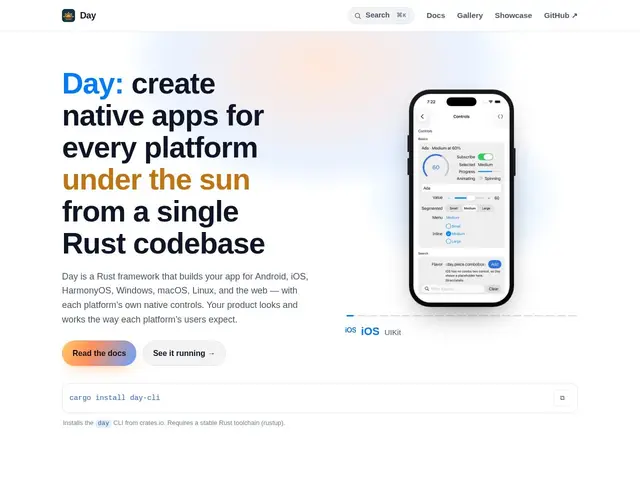
Description
Building an app that works well on phones, computers and the web usually means either writing it three or four times in different languages, or accepting a compromise where it looks and feels slightly "off" everywhere because it's rendered by a generic engine instead of the platform's real controls. Day Framework is built to avoid that tradeoff: you write your app once in Rust, and it renders with each platform's actual native UI components — AppKit on macOS, UIKit on iOS, Material on Android — so it looks and behaves like a proper native app rather than a cross-platform approximation.
Day is a Rust framework targeting eight platforms (Android, iOS, HarmonyOS, Windows, macOS, Linux and web) from one codebase, using a reactive binding system so UI updates are driven by state changes rather than full re-renders. It ships with a unified CLI for creating, testing, packaging and deploying apps (installed via `cargo install day-cli`), a testing/automation scripting language called Dayscript for writing repeatable UI tests and screenshots, and built-in AI integration through the Model Context Protocol (MCP) for AI-assisted development workflows. It also exposes modular device APIs (battery, clipboard, permissions, networking, local storage) and supports custom widgets with native code integration, localization and accessibility. No pricing is published, which is typical for an open, developer-facing framework at this stage.
💬 Our review
The short version: if you want genuinely native rendering across eight platforms from a single Rust codebase — not a WebView wrapper — Day Framework is a serious, well-documented option, but it's still an emerging framework competing against much larger ecosystems.
The pitch that differentiates Day from Flutter or React Native is native-first rendering: instead of drawing its own widgets, it drives each platform's actual UI toolkit, which tends to produce apps that look and feel right without the usual cross-platform "uncanny valley." The reactive binding system and built-in CLI (cargo install day-cli) suggest a genuinely usable developer workflow, not just a proof of concept, and the built-in Dayscript testing language plus MCP-based AI tooling are unusual, forward-looking additions. The catch is ecosystem size: Flutter and React Native have years of plugins, Stack Overflow answers and hiring pools that Day doesn't yet have, and being Rust-only raises the bar for teams without existing Rust experience. No pricing is published, so there's no visible monetization risk yet, but also no signal about long-term commercial backing. Worth serious evaluation for Rust-fluent teams building genuinely native multi-platform apps from scratch; not yet a safe bet if you need a large plugin ecosystem or an easy hiring pool today.
💰 Pricing
📊 Global score
🤖 AI-enriched data
Aucune page tarifaire publiée ; installation via cargo (gestionnaire de paquets Rust), typique d'un framework open-source en développement actif.
Pros
Rendu réellement natif par plateforme (AppKit, UIKit, Material) plutôt qu'un moteur de rendu générique
Un seul codebase Rust pour 8 plateformes (Android, iOS, HarmonyOS, Windows, macOS, Linux, web)
CLI unifiée (cargo install day-cli) pour créer, tester, packager et déployer
Langage de scripting Dayscript intégré pour tests automatisés et screenshots
Intégration IA via MCP pour des workflows de développement assistés
Cons
Écosystème naissant, bien plus petit que Flutter ou React Native
Réservé aux équipes maîtrisant Rust — barrière d'entrée plus haute
Aucune tarification publiée, modèle de financement/monétisation flou
Adoption encore limitée, peu de retours d'expérience en production