How Circuits Actually Work — for Programmers
A free interactive course that teaches electronics and embedded systems to software developers, from basic circuits to microcontroller integration.
🔗 Visit How Circuits Actually Work — for Programmers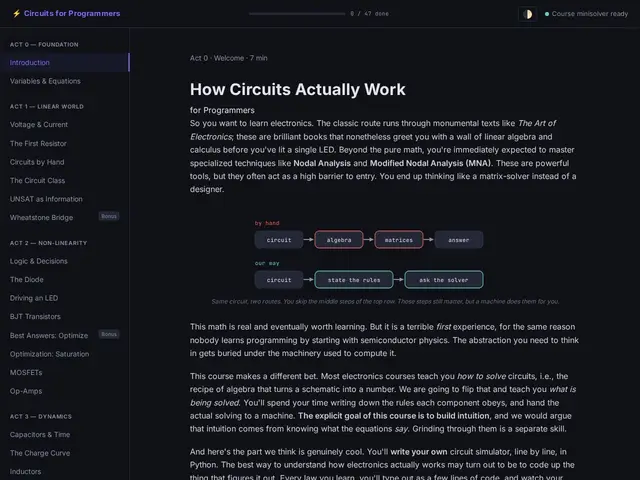
Description
If you've ever wired up an Arduino, flashed a microcontroller, or wondered what's actually happening inside a circuit board your code talks to, this is a free interactive course that walks you through electronics the way a programmer thinks — starting from voltage and current and building up to real embedded systems, without needing an electrical engineering degree.
How Circuits Actually Work is a browser-based curriculum built specifically for software developers who want to close the gap between the code they write and the hardware it runs on. It's organized into five progressive acts — foundational linear circuits (Ohm's law, Kirchhoff's laws, resistors), non-linear components (diodes, transistors, op-amps), dynamic behavior (capacitors, inductors, timing), practical microcontroller integration (UART, I2C, SPI, power budgeting), and system-level design with six capstone projects. Exercises use an interactive Z3 constraint solver so learners can check their circuit math directly in the browser instead of just reading static diagrams. There's no visible pricing page or account system, and no clear company behind it — it reads as an independent educational resource rather than a SaaS product.
💬 Our review
The short version: if you're a developer who's always nodded along at "it's just Ohm's law" without really knowing what that means, this free interactive curriculum is one of the more approachable ways to actually learn it, built around your existing mental model instead of an EE textbook's.
Most electronics education is written for electrical-engineering students and assumes prior vocabulary and math notation. This resource inverts that: it's written for people who already think in loops, state and debugging, and maps electronics concepts onto that frame. The progressive five-act structure with capstone projects and an interactive constraint solver makes it feel more like a well-designed course than a reference wiki. The tradeoffs are real: there's no visible pricing, account system, or company behind it, so its long-term maintenance is uncertain, and it's a pure learning resource — it won't help you design or simulate an actual circuit board (for that you'd want KiCad or a proper SPICE simulator). Best suited for backend/software developers picking up embedded or IoT work who want the "why" behind the hardware, not professional EE tooling.
💰 Pricing
📊 Global score
🤖 AI-enriched data
Aucune page pricing ni système de compte visible ; se présente comme une ressource éducative en accès libre, sans modèle commercial affiché.
Pros
Curriculum progressif structuré en 5 actes, du fondamental à l'avancé
Solveur de contraintes Z3 interactif pour vérifier ses calculs directement dans le navigateur
Pensé pour le vocabulaire mental d'un développeur, pas d'un étudiant en électronique
6 projets capstone pour appliquer les concepts de façon intégrée
Cons
Aucune tarification ni société identifiable derrière le projet — pérennité incertaine
Ressource purement pédagogique, pas un outil de conception ou de simulation de circuit réel
Pas de communauté ou d'interaction entre apprenants visible