PaymentKit
Billing platform that routes payments across multiple processors so a business doesn't lose revenue if one payment processor shuts down its account.
🔗 Visit PaymentKit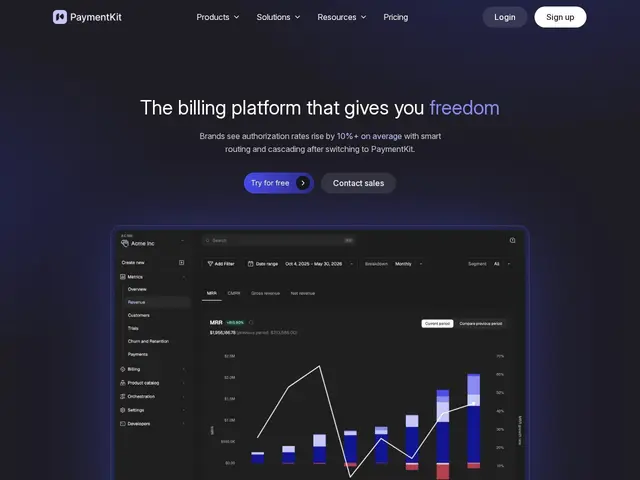
Description
Every online business that takes payments is quietly exposed to a single point of failure: if your one payment processor decides to close your account — which happens more than people realize, especially in "higher-risk" categories like subscriptions, travel or adult content — your revenue can stop overnight. PaymentKit's answer is to never depend on just one processor: it plugs your billing into several (Stripe, Adyen, Authorize.net, Paysafe) at once and automatically reroutes transactions if one goes down or declines.
Concretely, PaymentKit handles flat, tiered, usage-based and hybrid billing models, adds wallet support (Apple Pay, Google Pay), and layers in dunning/failed-payment recovery with smart retry logic on top of its processor-agnostic routing. It's priced at a flat $99/month plus 0.65% per transaction, with a custom plan for high-risk verticals that many payment platforms simply won't serve. It's a very fresh product (Product Hunt launch late August 2026), so track record is thin, but the underlying pitch — processor redundancy as insurance — addresses a real and specific risk that mainstream billing tools like Stripe Billing don't solve, since they only route through the one processor you're billing with.
💬 Our review
The short version: PaymentKit solves a narrow but real problem — processor account terminations — and is worth considering specifically if you're in a vertical (travel, high-ticket subscriptions, adult/dating) where getting cut off by Stripe or PayPal without warning is a genuine business risk, not a hypothetical.
The differentiator versus Chargebee, Recurly or plain Stripe Billing is the multi-processor routing itself — no mainstream billing tool treats "your processor might terminate you" as the core design problem. The 0.65% transaction fee is competitive if it actually saves you from a catastrophic processor shutdown even once.
The honest caveat: this is a launch-week product with no long-term track record yet, so due diligence on reliability and actual multi-processor failover behavior under load matters more than usual — ask for references before betting your primary revenue pipeline on it. If you're in a low-risk vertical with a stable Stripe relationship, you likely don't need this yet.
💰 Pricing
📊 Global score
🤖 AI-enriched data
99$/mois + 0,65% par transaction. Plan personnalisé pour les secteurs à haut risque.
Pros
Route les paiements sur plusieurs processeurs (Stripe, Adyen, Authorize.net, Paysafe) pour éviter une coupure de revenu
Gère facturation forfaitaire, par paliers, à l'usage et hybride
Relance automatique intelligente des paiements échoués (dunning)
Accepte des secteurs à haut risque que d'autres plateformes refusent
Cons
Produit très récent (lancement fin août 2026), historique de fiabilité encore mince
Frais de transaction (0,65%) qui s'ajoutent au forfait mensuel
Utile surtout pour des secteurs exposés à un risque réel de résiliation