Crawlee
A free, open-source toolkit that gives developers the plumbing needed to build web scrapers that keep working reliably — retrying failures, rotating proxies, and managing queues automatically.
🔗 Visit Crawlee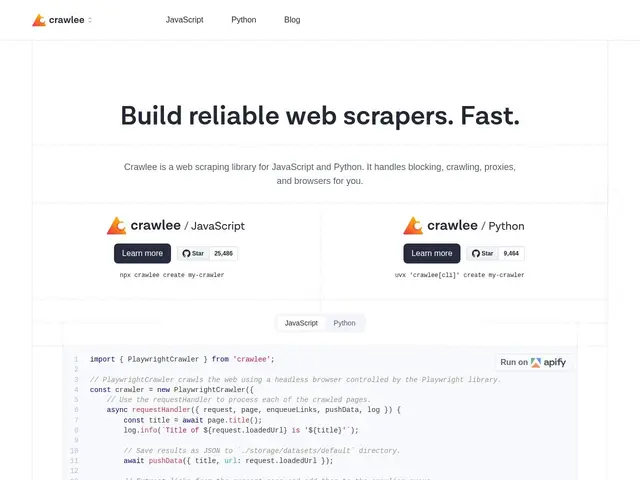
Description
Writing a basic script to pull data off a website is easy; writing one that still works after the site briefly goes down, blocks your IP address, or serves a slightly different page than expected is a much bigger job. Crawlee exists to handle that unglamorous, reliability-focused plumbing — think of it as the difference between a car that runs and one that also has working brakes, seatbelts, and a spare tire for when things don't go perfectly.
Crawlee is an open-source library for Node.js and Python (built by Apify) that provides browser and HTTP-based crawling with a unified API across Playwright, Puppeteer, Cheerio, and JSDOM, plus built-in proxy rotation, session management, automatic retries, URL queue management, and pluggable storage backends (local filesystem, Redis, SQL). With 25,000+ GitHub stars and an active Discord community, it's become one of the standard choices for developers who need to build production-grade crawlers rather than one-off scripts, and it scales from a single script on a laptop to enterprise-level scraping operations.
💬 Our review
The short version: Crawlee is the right layer to build on if you're writing scrapers as a developer and want the reliability plumbing (retries, proxy rotation, queue management) handled for you instead of rebuilt from scratch every project — it's free, mature, and actively maintained.
The unified API across headless-browser crawling (Playwright/Puppeteer, for JavaScript-heavy sites) and lightweight HTTP crawling (Cheerio, for static pages) is genuinely useful — you can start cheap and fast, and only pay the performance cost of a full browser when a site actually requires it. Built by the team behind Apify, a scraping-as-a-service platform, it also benefits from real production battle-testing rather than being a side project.
The honest limits: it's a code library for developers, not a no-code scraping tool — if you're not comfortable writing Node.js or Python, this isn't for you, and something like Ui.Vision's record-and-replay approach will get you further faster. It also doesn't solve the legal/ethical side of scraping (robots.txt compliance is supported but not enforced by default) or handle anti-bot systems that specifically fingerprint and block automated browsers, which still require extra tooling on top.
💰 Pricing
📊 Global score
🤖 AI-enriched data
Gratuit et open source (licence Apache 2.0). Aucun palier payant — développé par Apify, dont la plateforme cloud est un service séparé et payant.
Pros
Gratuit, open source, mature (25k+ étoiles GitHub, développé par Apify)
API unifiée entre crawling léger (Cheerio) et navigateur complet (Playwright/Puppeteer)
Gestion intégrée des retries, de la rotation de proxy et de la file d'URLs
Éprouvé en production, pas un simple projet expérimental
Cons
Bibliothèque de code pour développeurs — inutilisable sans savoir coder
Ne résout pas seul les systèmes anti-bot avancés qui fingerprintent les navigateurs automatisés
Le respect du robots.txt est supporté mais pas imposé par défaut