DeerFlow
An open-source framework from ByteDance for building AI agents that can spend minutes or hours working through a task — researching, writing code, and spinning up helper agents — rather than answering in one quick reply.
🔗 Visit DeerFlow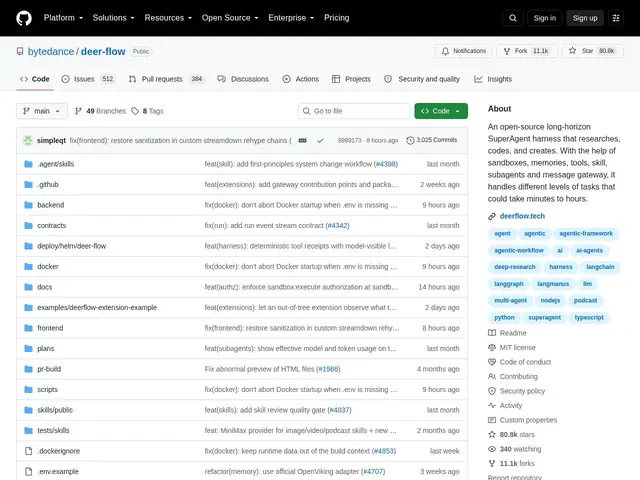
Description
A typical chatbot answers a question and stops. But some tasks — "research this topic thoroughly and write a report," or "refactor this codebase and verify the tests still pass" — need an AI to keep working over a long stretch, check its own progress, and sometimes delegate parts of the job to helper agents, the way a human might split a big project into smaller assigned pieces. DeerFlow is a toolkit for building exactly that kind of long-running, self-directed AI agent.
DeerFlow is ByteDance's open-source "SuperAgent harness," built on top of LangGraph, that provides the infrastructure for long-horizon agent tasks: spawning and coordinating sub-agents, persistent memory across a session, sandboxed execution (local, Docker, or Kubernetes) so an agent can safely run code, MCP server integration for connecting external tools, and hooks into messaging platforms (Slack, Telegram, WeChat) so an agent can be interacted with like a teammate. Version 2.0 was a ground-up rewrite that reached #1 on GitHub Trending in February 2026 and has grown to 80,000+ GitHub stars, with built-in observability via LangSmith and Langfuse and an authorization/safety framework for controlling what spawned sub-agents are allowed to do.
💬 Our review
The short version: DeerFlow is a serious choice for developers specifically building long-running, autonomous multi-agent systems — its scale (80k+ stars, backed by ByteDance) and depth of features (sandboxing, sub-agent spawning, safety controls) put it ahead of hobby-scale agent frameworks, though it's squarely aimed at technical teams, not a plug-and-play chatbot builder.
The sandboxed execution options (local, Docker, Kubernetes) and the explicit authorization framework for sub-agents are what separate it from simpler agent demos — running untrusted, AI-generated code safely is one of the genuinely hard problems in this space, and DeerFlow treats it as a first-class concern rather than an afterthought. Built on LangGraph gives it a proven orchestration foundation rather than reinventing graph-based state management from scratch.
The honest caveats: this is infrastructure for developers building agent systems, not an end-user product — there's a real setup and configuration investment before you get value, and the surface area (memory, sandboxes, MCP, messaging integrations) means a learning curve to use well. For a simple single-turn AI feature, this is significant overkill; it earns its complexity only once you actually need agents that run unsupervised for extended periods.
💰 Pricing
📊 Global score
🤖 AI-enriched data
Open source, licence MIT, gratuit — projet soutenu par ByteDance.
Pros
Échelle et maturité fortes — 80k+ étoiles GitHub, soutenu par ByteDance
Exécution en sandbox (local/Docker/Kubernetes) traitée comme un vrai sujet de sécurité
Framework d'autorisation dédié pour contrôler ce que peuvent faire les sous-agents
Construit sur LangGraph — fondation d'orchestration éprouvée
Cons
Infrastructure pour développeurs, pas un produit clé en main
Investissement de configuration réel avant d'en tirer de la valeur
Surdimensionné pour une simple fonctionnalité IA à un seul échange